Correct Option
The problem specifies that A, B, C, D, E, F, G, H, I are distinct digits. Given values are E = 0 and F = 8.
The given arithmetic relationships are:
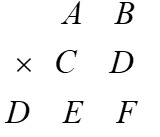
- AB × CD = DEF
- DEF + GHI = 975
Substitute E = 0 and F = 8 into DEF, yielding DEF = D08.
From equation (2):
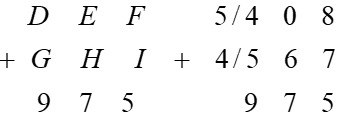
D08 + GHI = 975
Performing column addition:
- Units place: 8 + I = 5. For this to be true in base 10, 8 + I must equal 15 (with a carry-over of 1 to the tens place). Thus, I = 7.
- Tens place: 0 + H + (carry-over 1) = 7. This implies H + 1 = 7, so H = 6.
- Hundreds place: D + G = 9.
The distinct digits identified so far are E=0, F=8, I=7, H=6. The set of used digits is {0, 6, 7, 8}. The remaining available digits for A, B, C, D, G (which must be distinct from each other and from the used set) are {1, 2, 3, 4, 5, 9}.
Now, consider the condition D + G = 9, where D and G must be distinct and chosen from {1, 2, 3, 4, 5, 9}:
- If D = 1, then G = 8. However, 8 is already used (F=8). This case is invalid.
- If D = 2, then G = 7. However, 7 is already used (I=7). This case is invalid.
- If D = 3, then G = 6. However, 6 is already used (H=6). This case is invalid.
- If D = 4, then G = 5. Both 4 and 5 are available and distinct. This is a potential solution.
- If D = 5, then G = 4. Both 5 and 4 are available and distinct. This is a potential solution.
- If D = 9, then G = 0. However, 0 is already used (E=0). This case is invalid.
We proceed with the two potential cases:
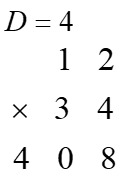
Case 1: D = 4 and G = 5.
The set of used digits expands to {0, 4, 5, 6, 7, 8}. The remaining available digits for A, B, C (which must be distinct) are {1, 2, 3, 9}.
From equation (1): AB × CD = D08. Substituting D = 4, we get AB × C4 = 408.
We need to find a 2-digit number AB and a 2-digit number C4 (where C is from {1, 2, 3, 9}) such that their product is 408:
- If C = 1, then CD = 14. AB = 408 / 14 = 29.14 (not an integer). Invalid.
- If C = 2, then CD = 24. AB = 408 / 24 = 17. This implies A = 1, B = 7. Let's check the distinctness of all digits: A=1, B=7, C=2, D=4, E=0, F=8, G=5, H=6, I=7. Here, B=7 and I=7. These are not distinct. Invalid.
- If C = 3, then CD = 34. AB = 408 / 34 = 12. This implies A = 1, B = 2. Let's check the distinctness of all digits: A=1, B=2, C=3, D=4, E=0, F=8, G=5, H=6, I=7. All nine digits {0, 1, 2, 3, 4, 5, 6, 7, 8} are distinct. This is a valid solution. Thus, A = 1, B = 2, C = 3.
Case 2: D = 5 and G = 4.
The set of used digits expands to {0, 4, 5, 6, 7, 8}. The remaining available digits for A, B, C (which must be distinct) are {1, 2, 3, 9}.
From equation (1): AB × CD = D08. Substituting D = 5, we get AB × C5 = 508. A number ending in 5, when multiplied by any integer, will always result in a product ending in either 0 or 5. However, 508 ends in 8. Therefore, AB × C5 cannot be 508. This case is invalid.
The only valid solution is A = 1, B = 2, C = 3. The question asks for the value of A + B + C. A + B + C = 1 + 2 + 3 = 6.
Incorrect Options
Options 2 (7), 3 (8), and 4 (9) are incorrect because they do not align with the unique set of distinct digits (A, B, C, D, E, F, G, H, I) that satisfy all the given arithmetic conditions (AB × CD = DEF and DEF + GHI = 975) and the initial constraints (E=0, F=8, and all digits being distinct). Any alternative sum for A+B+C would necessitate a different assignment of digits, which would inevitably violate one or more of the established conditions, such as digit distinctness or the specified arithmetic results.