Correct Option (4)
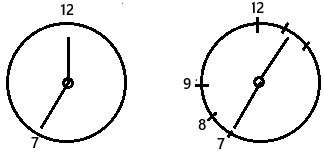
The hour hand and the minute hand of a clock make an angle of 180° when they are directly opposite to each other. To determine this time, we can calculate the relative movement of the hands.
- The minute hand moves at a rate of 6° per minute.
- The hour hand moves at a rate of 0.5° per minute.
- At 7:00 hours, the hour hand is exactly at 7 (210° from the 12 o'clock mark), and the minute hand is at 12 (0°). The initial angle between them is 210°.
- For the hands to be 180° apart, the minute hand must gain (210° - 180°) = 30° on the hour hand.
- Let 't' be the number of minutes past 7:00 hours.
- The angle covered by the minute hand in 't' minutes = 6t degrees.
- The angle covered by the hour hand in 't' minutes = 0.5t degrees.
- The position of the hour hand at 't' minutes past 7:00 is (210 + 0.5t) degrees.
- The position of the minute hand at 't' minutes past 7:00 is 6t degrees.
- For a 180° angle, the difference in their positions should be 180°. Considering the hour hand is ahead of the minute hand in this specific interval: (210 + 0.5t) - 6t = 180 210 - 5.5t = 180 30 = 5.5t t = 30 / 5.5 = 300 / 55 = 60 / 11 minutes.
- 60/11 minutes is approximately 5.45 minutes.
- Therefore, the hands make an angle of 180° at approximately 7 hours and 5.45 minutes. This time falls within the interval between 7:05 hours and 7:10 hours.
Incorrect Options:
- Option 1: At 7:00 hours
At 7:00 hours, the minute hand is at 12 (0°) and the hour hand is at 7 (210°). The angle between them is 210°, not 180°.
- Option 2: Between 7:00 hours and 7:05 hours
The calculation shows that the 180° angle occurs at approximately 7:05.45 hours. This time is after 7:05 hours, making this interval incorrect.
- Option 3: At 7:05 hours
At 7:05 hours, the minute hand is at 1 (30°). The hour hand has moved slightly past 7, to 210° + (5 × 0.5°) = 210° + 2.5° = 212.5°. The angle between them is 212.5° - 30° = 182.5°, which is not exactly 180°.