Correct Option (4)
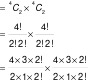
To form a parallelogram from two sets of parallel lines, two lines must be selected from the first set and two lines must be selected from the second set. The order of selection does not matter, indicating the use of combinations.
- Number of parallel lines in the first set = 4.
- Number of parallel lines in the second set = 4.
- The number of ways to choose 2 lines from the first set of 4 parallel lines is given by the combination formula C(n, r) = n! / (r!(n-r)!):
C(4, 2) = 4! / (2!(4-2)!) = (4 × 3 × 2 × 1) / ((2 × 1) × (2 × 1)) = 12 / 2 = 6. - Similarly, the number of ways to choose 2 lines from the second set of 4 parallel lines is:
C(4, 2) = 6. - The total number of parallelograms formed is the product of these two combinations:
Total parallelograms = C(4, 2) × C(4, 2) = 6 × 6 = 36.
Incorrect Options:
Options 1 (18), 2 (24), and 3 (32) are incorrect. These values do not result from the accurate application of combinatorial principles required to determine the number of parallelograms formed by the intersection of two sets of four parallel lines.