Correct Option (3)
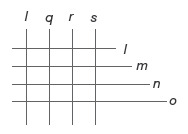
The problem requires determining the total number of distinct rectangles and squares that can be formed by 4 horizontal and 4 vertical parallel, equidistant lines.
A grid formed by 4 horizontal and 4 vertical lines effectively creates a 3x3 grid of unit squares.
To calculate the total number of rectangles (which includes squares):
- A rectangle is defined by selecting any two distinct horizontal lines and any two distinct vertical lines.
- The number of ways to choose 2 horizontal lines from 4 is given by the combination formula C(n, k) = n! / (k!(n-k)!), so C(4, 2) = (4 × 3) / (2 × 1) = 6.
- Similarly, the number of ways to choose 2 vertical lines from 4 is C(4, 2) = (4 × 3) / (2 × 1) = 6.
- The total number of rectangles (including squares) is the product of these combinations: 6 × 6 = 36.
To calculate the number of squares specifically:
- For 1x1 squares: A 3x3 grid contains 3 rows and 3 columns of unit squares. Number of 1x1 squares = 3 × 3 = 9.
- For 2x2 squares: Within a 3x3 grid, there are 2 rows and 2 columns of 2x2 squares. Number of 2x2 squares = 2 × 2 = 4.
- For 3x3 squares: There is 1 row and 1 column of 3x3 squares. Number of 3x3 squares = 1 × 1 = 1.
- The total number of squares = 9 + 4 + 1 = 14.
The number of rectangles that are not squares can be found by subtracting the total number of squares from the total number of rectangles:
- Number of non-square rectangles = Total rectangles (including squares) - Total squares
- Number of non-square rectangles = 36 - 14 = 22.
The question asks for the maximum number of "rectangles and squares," which implies the sum of rectangles that are not squares and the squares themselves.
- Total = (Number of non-square rectangles) + (Number of squares)
- Total = 22 + 14 = 36.
Therefore, the maximum number of rectangles and squares that can be formed is 36.
Incorrect Options:
Options 1 (16), 2 (24), and 4 (42) are incorrect. These values do not correspond to the accurate calculation of all possible rectangles and squares formed by the given configuration of lines. The systematic application of combinatorial principles and enumeration of squares of various sizes, as demonstrated, leads to a total of 36.