Correct Option (3)
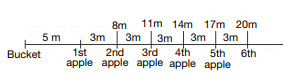
The problem requires calculating the total distance covered by a competitor who collects 6 apples, one at a time, and drops them into a bucket. For each apple, the competitor runs from the bucket to the apple and then back to the bucket. Therefore, the distance covered for each apple is twice its distance from the bucket.
- The bucket is the starting point.
- The first apple is 5 meters from the bucket.
- All other apples are placed 3 meters apart from the previous one.
The distances of the apples from the bucket are calculated as follows:
- Apple 1: 5 m
- Apple 2: 5 m + 3 m = 8 m
- Apple 3: 8 m + 3 m = 11 m
- Apple 4: 11 m + 3 m = 14 m
- Apple 5: 14 m + 3 m = 17 m
- Apple 6: 17 m + 3 m = 20 m
The total distance run by the competitor is the sum of twice the distance for each apple:
Total distance = 2 × (Distance of Apple 1 + Distance of Apple 2 + Distance of Apple 3 + Distance of Apple 4 + Distance of Apple 5 + Distance of Apple 6)
Total distance = 2 × (5 + 8 + 11 + 14 + 17 + 20)
Total distance = 2 × 75
Total distance = 150 m
Incorrect Options:
-
Option 1 (40 m): This value represents only the distance covered for collecting the sixth apple (2 × 20 m = 40 m), not the cumulative total distance for all six apples.
-
Option 2 (50 m): This value does not correspond to any logical calculation or partial sum derived from the problem's conditions.
-
Option 4 (75 m): This value represents the sum of the distances of all apples from the bucket (5 + 8 + 11 + 14 + 17 + 20 = 75 m). It incorrectly omits the return journey for each apple, which means the actual distance run is double this sum.