Correct Option
The total number of students appearing in the examination is 130.
Given data:
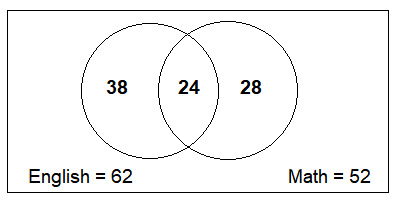
- Number of students who failed in English (E) = 62
- Number of students who failed in Mathematics (M) = 52
- Number of students who failed in both English and Mathematics (E ∩ M) = 24
To determine the number of students who failed in at least one subject, the principle of inclusion-exclusion is applied:
Number of students failed in English or Mathematics = n(E U M) = n(E) + n(M) - n(E ∩ M)
n(E U M) = 62 + 52 - 24
n(E U M) = 114 - 24
n(E U M) = 90
The number of students who passed finally is calculated by subtracting the number of students who failed in at least one subject from the total number of students:
Number of students passed = Total students - n(E U M)
Number of students passed = 130 - 90
Number of students passed = 40
Incorrect Options
Options 2 (50), 3 (55), and 4 (60) are incorrect. These values do not result from the accurate application of set theory principles to calculate the number of students who passed. The correct calculation, based on the given data and the principle of inclusion-exclusion, yields 40 as the number of students who passed.