Correct Option (3)
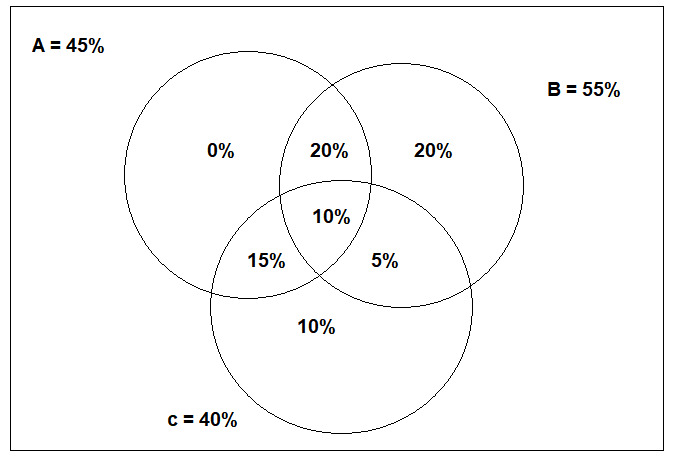
To determine the percentage of the population who do not read any magazine, we first calculate the percentage of the population who read at least one magazine. This can be achieved using the Principle of Inclusion-Exclusion for three sets.
Let P(A), P(B), P(C) represent the percentages of people reading magazines A, B, and C, respectively:
- P(A) = 45%
- P(B) = 55%
- P(C) = 40%
Let P(A ∩ B), P(B ∩ C), P(A ∩ C) represent the percentages reading two specific magazines:
- P(A ∩ B) = 30%
- P(B ∩ C) = 15%
- P(A ∩ C) = 25%
Let P(A ∩ B ∩ C) represent the percentage reading all three magazines:
- P(A ∩ B ∩ C) = 10%
The percentage of people reading at least one magazine, denoted as P(A ∪ B ∪ C), is given by the formula:
P(A ∪ B ∪ C) = P(A) + P(B) + P(C) - P(A ∩ B) - P(B ∩ C) - P(A ∩ C) + P(A ∩ B ∩ C)
Substituting the given values into the formula:
P(A ∪ B ∪ C) = 45% + 55% + 40% - 30% - 15% - 25% + 10%
P(A ∪ B ∪ C) = 140% - 70% + 10%
P(A ∪ B ∪ C) = 70% + 10%
P(A ∪ B ∪ C) = 80%
Therefore, the percentage of the population who do not read any magazine is calculated by subtracting the percentage of those who read at least one magazine from the total population (100%):
Percentage not reading any magazine = 100% - P(A ∪ B ∪ C) = 100% - 80% = 20%.
Incorrect Options:
Options 1 (10%), 2 (15%), and 4 (25%) are incorrect. These values do not represent the accurate percentage of the population that does not read any magazine. Such results typically arise from errors in applying the Principle of Inclusion-Exclusion or from incorrect calculation of the individual segments within the Venn diagram.