Correct Option (D)
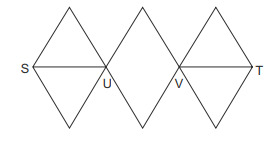
The problem requires calculating the total number of distinct routes from point S to point T, passing sequentially through points U and V, without retracing any path. This scenario is addressed using the fundamental principle of counting, also known as the multiplication principle.
- The number of distinct routes from S to U is 3.
- The number of distinct routes from U to V is 2.
- The number of distinct routes from V to T is 3.
Since the selection of a route for each segment (S to U, U to V, and V to T) is an independent event, the total number of possible routes from S to T is the product of the number of routes in each segment:
Total routes = (Routes S to U) × (Routes U to V) × (Routes V to T)
Total routes = 3 × 2 × 3 = 18.
Incorrect Options:
Options A (3), B (6), and C (9) are incorrect because they do not represent the complete application of the fundamental principle of counting for the entire sequence of routes from S to T via U and V. These values might correspond to the number of routes in a single segment, an incomplete product of segments, or an incorrect summation of route possibilities, rather than the comprehensive multiplicative combination required for sequential, independent choices.