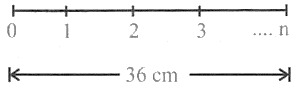
Correct Option (B)
The problem describes a line segment 36 cm long where points are marked from both ends. The marking pattern is sequential: the first point is 1 cm from the end, the second is 2 cm from the first, the third is 3 cm from the second, and so on. This implies that the distance of the n-th point from its respective end is the sum of the first n natural numbers, calculated by the formula Sn = n(n+1)/2.
- Points marked from the left end:
- 1st point: 1 cm (S₁ = 1)
- 2nd point: 1 + 2 = 3 cm (S₂ = 3)
- 3rd point: 3 + 3 = 6 cm (S₃ = 6)
- 4th point: 6 + 4 = 10 cm (S₄ = 10)
- 5th point: 10 + 5 = 15 cm (S₅ = 15)
- 6th point: 15 + 6 = 21 cm (S₆ = 21)
- 7th point: 21 + 7 = 28 cm (S₇ = 28)
- 8th point: 28 + 8 = 36 cm (S₈ = 36, which is the right end of the line segment)
- Points marked from the right end:
The same pattern applies from the right end. To compare these with points marked from the left, their positions are expressed as distances from the left end (36 cm - distance from the right end).
- 1st point (1 cm from right): 36 - 1 = 35 cm from left
- 2nd point (3 cm from right): 36 - 3 = 33 cm from left
- 3rd point (6 cm from right): 36 - 6 = 30 cm from left
- 4th point (10 cm from right): 36 - 10 = 26 cm from left
- 5th point (15 cm from right): 36 - 15 = 21 cm from left
- 6th point (21 cm from right): 36 - 21 = 15 cm from left
- 7th point (28 cm from right): 36 - 28 = 8 cm from left
- 8th point (36 cm from right): 36 - 36 = 0 cm from left (which is the left end of the line segment)
Now, applying the given conditions:
- "If the points on the ends are not counted":
- From the left-marked points, the point at 36 cm (the right end) is excluded. This leaves 7 points: {1, 3, 6, 10, 15, 21, 28}.
- From the right-marked points, the point at 0 cm (the left end) is excluded. This leaves 7 points: {35, 33, 30, 26, 21, 15, 8}.
- "and the common points are counted as one":
- Comparing the two sets of remaining points: {1, 3, 6, 10, 15, 21, 28} and {35, 33, 30, 26, 21, 15, 8}.
- The common points are 15 cm and 21 cm. These two distinct positions are present in both sets, meaning they have been counted twice in the initial sum of 14.
- To count these common points as one, we subtract the number of common points from the total.
Incorrect Options:
- (A) 10: This value would result from an incorrect calculation, potentially by misidentifying the number of common points or by erroneously excluding additional points beyond those specified.
- (C) 14: This count represents the total number of points if the end points are excluded, but the common points (15 cm and 21 cm) are still counted twice. It fails to apply the condition that common points are to be counted as one.
- (D) 16: This value represents the total number of points marked from both ends (8 from the left, 8 from the right) without excluding the end points (0 cm and 36 cm) and without accounting for the common points (15 cm and 21 cm) being counted as one. It does not adhere to the problem's conditions.