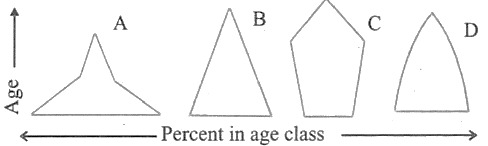
Correct Option (C)
An age pyramid indicating a declining population is characterized by a narrow base, which represents a low proportion of young individuals (0-14 years). This signifies a birth rate that is below the replacement level. The middle and older age groups may constitute a relatively larger proportion of the population. This structure suggests that the number of deaths exceeds the number of births, leading to an overall decrease in population size. Pyramid C visually depicts these characteristics, with a constricted base and a wider middle section, consistent with a declining population trend.
Incorrect Options:
-
Option A: This type of age pyramid typically represents an expansive or rapidly growing population. It features a very wide base, indicating high birth rates and a large proportion of young dependents. The pyramid tapers sharply towards the top, reflecting higher mortality rates in older age groups.
-
Option B: This pyramid generally illustrates a stable or slow-growing population. The base is moderately wide, and the pyramid tapers gradually, suggesting that birth rates are close to replacement levels and death rates are relatively low. The proportions across different age groups are more balanced compared to an expansive pyramid.
-
Option D: Without the visual, if C represents a declining population, D would typically represent either a stable population or one with slow growth, similar to or a variation of B. It would not exhibit the distinct narrow base characteristic of a population in decline.