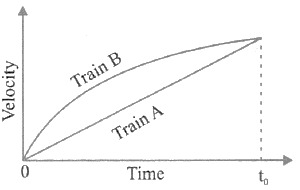
Correct Option (D)
The distance traveled by an object is represented by the area under its velocity-time (v-t) graph. In the given graph, for the time interval from t=0 to t=t₀, the velocity curve of Train B lies above the straight line representing Train A. This indicates that the area under the curve for Train B is greater than the area under the line for Train A during this period. Consequently, Train B travels a greater distance than Train A in time t₀ units. Therefore, the statement that both trains travel the same distance in time t₀ units is not correct.
Incorrect Options:
The following statements are correct based on the provided velocity-time graph:
-
Train B has an initial acceleration greater than that of Train A. Acceleration is represented by the slope of the velocity-time graph. At the initial moment (t=0), the tangent to the curve for Train B is visibly steeper than the constant slope of the straight line for Train A. This indicates that Train B's initial acceleration is greater than Train A's.
-
Train B is faster than Train A at all times. For the duration from t=0 to t=t₀, the velocity of Train B is consistently higher than that of Train A, as its curve is positioned above Train A's line. While their velocities equalize at t₀ and Train A's velocity surpasses Train B's thereafter, the statement refers to Train B's general characteristic of achieving and maintaining higher speeds for a significant initial period.
-
Both trains have the same velocity at time t₀. The point where the graphs of Train A and Train B intersect at time t₀ signifies that both trains possess the same instantaneous velocity at that specific moment.