Algebra PYQ — Page 8
CUET UG Mathematics — Algebra previous year questions with solutions.
All Algebra Questions (1106)
The inequality $\frac{5x - 2}{3} - \frac{7x - 3}{5} > \frac{x}{4}$ holds when
Let $A = [a_{ij}]$ be a square matrix of order 3 with each entry either 0 or 1, then the number of all such possible matrices is:
For the linear programming problem (LPP), $Maximize Z = 7x + 9y$, subject to constraints, $x - y \le -1, -x + y \le 0, x, y \ge 0.$ Which of the following is correct?
In a game, a man wins Rs. 5 for getting a number greater than 4 and loses Rs. 1 otherwise, when a fair dice is thrown. The man decided to throw a die thrice but to quit as and when he gets a number greater than 4. The expected value of the amount(in Rs.) he wins or loses is:
Match List-I with List-II if $P(A) = \frac{3}{7}$, $P(B) = \frac{4}{7}$ and $P(A \cup B) = \frac{5}{7}$ | List-I | List-II | | :--- | :--- | | (A) $P(A \cap B)$ | (I) $\dfrac{2}{3}$ | | (B) $P(A \mid B)$ | (II) $\dfrac{5}{7}$ | | (C) $P(B \mid A)$ | (III) $\dfrac{1}{2}$ | | (D) $P(A' \cup B')$ | (IV) $\dfrac{2}{7}$ | Choose the correct answer from the options given below:
If $2P(A) = P(B) = \frac{5}{13}$ and $P(A|B) = \frac{2}{5}$, then $P(A \cap B)$ is
If A is a matrix of order $m × n$ and $B$ is a matrix such that $AB^T$ and $B^TA$ are both well-defined matrices, then order of matrix B is
The feasible region represented by the constraints $x + y \leq 50, 3x + y \leq 90, x \geq 0, y \geq 0$ of an LPP is 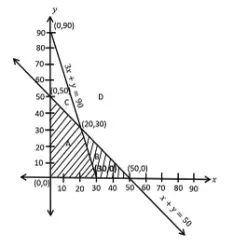
Match List-I with List-II | List-I | List-II | |---|---| | (Matrix A) | (Determinant of adj A) | | (A) $\begin{bmatrix} 2 & 1 \\ 0 & -1 \end{bmatrix}$ | (I) 6 | | (B) $\begin{bmatrix} 0 & 1 \\ 4 & -1 \end{bmatrix}$ | (II) 5 | | (C) $\begin{bmatrix} 1 & 2 \\ -3 & -1 \end{bmatrix}$ | (III) -4 | | (D) $\begin{bmatrix} 4 & -2 \\ 3 & 0 \end{bmatrix}$ | (IV) -2 | Choose the correct answer from the options given below:
If A and B are two events such that $P(A) = \frac{1}{2}$, $P(B) = \frac{1}{3}$, $P(B|A) = \frac{1}{4}$, then $P(A|B)$ is:
If $A = \begin{bmatrix} 3 & -2 & 3 \\ 2 & 1 & -1 \\ 4 & -3 & 2 \end{bmatrix}$, then the matrix (adj A)A is equal to
Let $A = [a_{ij}]_{n \times n}$ be a matrix, then match List-I with List-II | List-I | List-II | | --- | --- | | (A) $\vert A\vert = 0$ | (I) $A$ is a symmetric matrix | | (B) $\vert A\vert \neq 0$ | (II) $A$ is a skew-symmetric matrix | | (C) $A^T = A$ | (III) $A$ is a singular matrix | | (D) $A^T = -A$ | (IV) $A$ is a non-singular matrix | Choose the correct answer from the options given below:
If $\begin{vmatrix} -a^2 & ab & ac \\ ba & -b^2 & bc \\ ac & bc & -c^2 \end{vmatrix} = k \cdot a^l b^m c^n$, then Match List-I with List-II | List-I | List-II | |---|---| | (A) $l = m = n =$ | (I) 10 | | (B) $k + l + m + n =$ | (II) 6 | | (C) $k^2 + l^2 + (m - n)^2 =$ | (III) 2 | | (D) $l^2 + m^2 + (n - k) =$ | (IV) 20 | Choose the correct answer from the options given below:
The random variable $x$ has a probability distribution $p(x)$ of the form $P(x=r)=\begin{cases} rk, & \text{if } r \le 2, \\ (r-1)k, & \text{if } 2<r\le 4, \\ 0, & \text{otherwise,} \end{cases}$ where $r \in \mathbb{N}\cup\{0\}$ and $k\in\mathbb{R}$, where $\mathbb{N}$ is the set of natural numbers. Then: (A) $k=\frac{1}{9}$ (B) $P(2\le x\le 3)=\frac{1}{2}$ (C) $P(x=4)=\frac{1}{3}$ (D) $P(x>1)=\frac{7}{8}$ Choose the correct answer from the options given below.
If a matrix has 12 elements, then the possible orders it can have, are (A) 1 × 12 (B) 4 × 3 (C) 6 × 3 (D) 6 × 2 Choose the correct answer from the options given below:
If the random variable X is normally distributed with mean 16 and standard deviation 4, then the standard normal variable Z corresponding to X = 17 is
A vector of magnitude 8 units in the direction perpendicular to both the vectors $\hat{i} + \hat{j} + \hat{k}$ and $2\hat{i} + \hat{k}$ is
If matrix $A = \begin{bmatrix} p & -3 \\ -4 & p \end{bmatrix}$ and $|A^3| = 64$, then the value of p is:
The corner points of the bounded feasible region for a linear programming problem (LPP) are (0, 3/2), (1, 2) and (4, 0). If the objective function is Z = ax + by, where 'a' and 'b' are positive, then the condition on 'a' and 'b' so that the maximum of Z occurs at (1, 2) and (4, 0) is:
Consider the linear programming problem (LPP): Maximize Z = 6x + 3y subject to the conditions, 4x + y ≥ 80, x + 5y ≥ 115, 3x + 2y ≤ 150, x, y ≥ 0. In reference to the above LPP, which of the following are correct? (A) The feasible region is bounded. (B) The corner points of the feasible region are (15, 20), (40, 15) and (0, 75). (C) The maximum value of the objective function is 285. (D) The LPP does not have optimal solution. Choose the correct answer from the options given below:
If A is a square matrix of order 3 and $|A| = 4$, then the value of $|2A^T|$ is
In class XII, suppose 5% of boys and 0.25% of girls are physically fit for a game. A fit student is selected at random from this class having same number of boys and girls. If the probability that the selected student is a girl is $\frac{m}{n}$, gcd(m, n) = 1, then m + n is equal to
The vector in the direction of the vector $2\hat{i} - \hat{j} - 2\hat{k}$ that has magnitude 9 units is:
Let $\vec{a} = 2\hat{i} - \hat{j}, \vec{b} =- 4\hat{j} + k\,\text{and}\,\vec{c} = \hat{i} + 2\hat{k}$. If $\vec{d}$ is a vector perpendicular to both $\vec{a}$ and $\vec{b}$ such that $\vec{c} \cdot \vec{d} = 34$, then $|\vec{d}|$ is equal to