Algebra PYQ — Page 26
CUET UG Mathematics — Algebra previous year questions with solutions.
All Algebra Questions (1106)
Let box I contains 3 black and 4 white balls, box II contains 2 black and 2 white balls, box III contains 4 black and 3 white balls. A box is selected at random and then a ball is randomly drawn from the selected box. If the color of the ball is black then the probability that the ball is drawn from box III, is:
Which of the following functions from $\mathbb{Z}$ to $\mathbb{Z}$ is a bijective function? (where $\mathbb{Z}$ is set of integers)
The feasible region corresponding to the linear constraints of a Linear Programming Problem (LPP) is represented by the shaded region in the given figure. Which of the following is not a constraint to the given LPP? 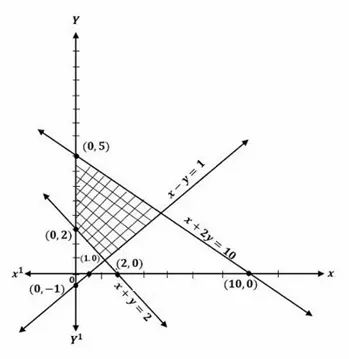
If A and B are independent events such that $P(A|B) = \frac{1}{3}$ and $P(B) = \frac{1}{2}$, then the value of $P(A \cap B)$ is equal to
If A is an invertible symmetric matrix, then A⁻¹ is
The matrix $A = \begin{bmatrix}0 & 0 & 5\\0 & 5 & 0\\5 & 0 & 0\end{bmatrix}$ is a (A) Diagonal matrix (B) Scalar matrix (C) Square matrix (D) Symmetric matrix Choose the correct answer from the options given below:
Match List-I with List-II | List-I | List-II | | --- | --- | | Matrix Product | Order of resultant matrix | | --- | --- | | (A) $[a_{ij}]_{2 \times 3} \times [b_{ij}]_{3 \times 4}$ | (I) $2 \times 4$ | | (B) $[a_{ij}]_{2 \times 1} \times [b_{ij}]_{1 \times 3}$ | (II) Not possible | | (C) $[a_{ij}]_{3 \times 2} \times [b_{ij}]_{3 \times 2}$ | (III) $3 \times 3$ | | (D) $[a_{ij}]_{3 \times 3} \times [b_{ij}]_{3 \times 3}$ | (IV) $2 \times 3$ | Choose the correct answer from the options given below:
The function $f: \mathbb{R} \rightarrow [-1, 1]$ defined by $f(x) = \cos x$ is:
For a linear programming problem, the feasible region is shown in the figure by shaded portion, then linear constraints are 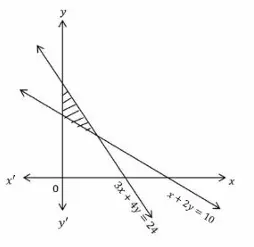
Let the matrix $A = [a_{ij}]_{3\times3}$ be defined by $a_{ij} = \begin{cases} 2i + 3j, & i < j \\ 5, & i = j \\ 3i - 2j, & i > j \end{cases}$ The number of elements in the matrix A which are greater than 7, is:
Let $A$ be a non singular matrix of order $n \times n$, Then $|\text{adj }(3A)|$ is equal to:
Which of the following statements are correct? (A) If A is a square matrix, then $|A^2| = |A|^2$. (B) If A and B are square matrices of the same order, then det (AB) = det (A) + det (B). (C) If A is a square matrix of order 3 and $|A|=2$, then the value of $|-3A|$ is 54. (D) If the matrix $\begin{bmatrix} 5 -x & x -1 \\ 3 &5 \end{bmatrix}$ is singular, then the value of x is 7/2. Choose the correct answer from the options given below:
If the matrix $A = \begin{bmatrix} 1 & 3 \\ 2 & 1 \end{bmatrix}$, then the value of det $(A^2 - 2A)$ is equal to
The value of $\begin{vmatrix} 7! & 8! & 9! \\ 8! & 9! & 10! \\ 9! & 10! & 11! \end{vmatrix}$ is:
If $\begin{bmatrix} 1 & 3 \\ 2 & 4 \end{bmatrix} \begin{bmatrix} 3 & 5 \\ -1 & 3 \end{bmatrix} = \begin{bmatrix} m & 14 \\ 2 & n \end{bmatrix}$, then $m + n$ is equal to
If $A = \begin{bmatrix} -1 & 2 & 3x \\ 2y & 4 & -1 \\ 6 & -1 & 0 \end{bmatrix}$ is a symmetric matrix, then the value of $2x - y$ is:
The system of equations $x + y + z = 4$ $x + 2y + 3z = 12$ $x + 3y + \lambda z = \mu$ has a unique solution if
If $A = \begin{bmatrix} a & 1 & -1 \\ 0 & b & 4 \\ 4 & 4 & c \end{bmatrix}$ and $abc = 12$, $b = 4a$, then the value of $|A(adjA)|$ is:
Match List-I with List-II | List-I | List-II | | --- | --- | | (A) A square matrix $P$ is said to be non-singular if | (I) $\vert P\vert = 0$ | | (B) A square matrix $P$ is said to be singular if | (II) $P P^T$ is symmetric | | (C) If a matrix $P$ is both symmetric and skew-symmetric, then | (III) $\vert P\vert \neq 0$ | | (D) If $P$ is a square matrix, then | (IV) $P$ is a null matrix | Choose the correct answer from the options given below:
If $\vec{a}, \vec{b}, \vec{c}$ are three mutually perpendicular unit vectors, then $|\vec{a} + \vec{b} + \vec{c}|$ is equal to
If $A = \begin{bmatrix} a & 4 & -5 \\ d & b & -6 \\ 5 & e & c \end{bmatrix}$ is a skew symmetric matrix, then value of $a + b + c + d + e$ is equal to
Let $A = [a_{ij}]$ is given by $A = \begin{bmatrix} 1 & -1 & 2 \\ 3 & 4 & -5 \\ 2 & -1 & 3 \end{bmatrix}$. Then the matrix $B = [b_{ij}]$, where $b_{ij}$ = Minor of $a_{ij}$ is:
For the objective function Z=-4x + 6y subject to the constraints 3x + 2y ≥ 5, 7x + 2y ≤ 9, x ≥ 0, y ≥ 0, the maximum value of Z occurs at $(a, b)$ and the minimum value of Z occurs at $(p, q)$ then the value of $\frac{a}{p} + \frac{b}{q}$ is:
If the matrix $\begin{bmatrix}2 & -1 & 3\\ \lambda & 0 & 7\\-1 & 1 & 4\end{bmatrix}$ is not invertible, then value of $\lambda$ is