CUET UG Mathematics — Algebra previous year questions with solutions.
If $a$, $b$ and $c$ are distinct prime numbers then the value of $\begin{vmatrix} a-b & b-c & c-a \\ b-c & c-a & a-b \\ c-a & a-b & b-c \end{vmatrix}$ is equal to
The system of equations $x - 3y - 8z = -10$ $2x + 5y + \lambda z = 13$ $3x + y - 4z = 0$ has infinite number of solutions if the value of $\lambda$ is equal to:
If $A$ is a square matrix and $I$ is an identity matrix of same order such that $A^2 = A$, then $(2I + A)^2 - 5A$ is
The region represented by the system of inequalities $x, y \geq 0, y \leq 6, x + y \leq 3$
If the roots of the equation x² - 5x + k = 0 are in the ratio 2:3, then the value of k is:
If $A = [a_{ij}]$ be square matrix of order 3, such that $a_{ij} = i + j$, $\forall i, j$ then which of the following are correct? (A) A is a skew-symmetric matrix. (B) A is a non-singular matrix. (C) The inverse of A does not exist. (D) A is a symmetric matrix. Choose the correct answer from the options given below:
A function $f: \mathbb{R} \rightarrow \mathbb{R}$ defined by $f(x) = \frac{x}{x^2+1}$ is (where $\mathbb{R}$ is a set of real number)
Assume $P$, $Q$, $R$ and $W$ are matrices of order $3 \times 3$, $a \times 4$, $b \times c$ and $d \times a$ respectively. If $PQ + WR$ is well defined, then the value of $ab + cd$ is:
If A is a square matrix such that $A^2 = A$ and I is the identity matrix of same order as A, then the value of $(A-2I)^2 - (2A + I)^2 + 11A$ is:
The graph given below represents which of the following function? 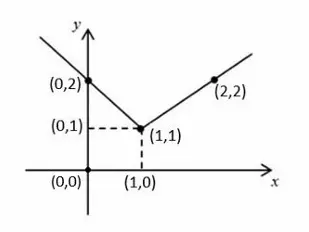
Consider the Linear Programming Problem Maximize $z = x + y$ Subject to the constraints $x - y \leq -1$, $x \geq y$, $x \geq 0, y \geq 0$ Then which one of the following is TRUE?
The value(s) of $K$, for which the system of linear equations $2x + y + z = 1, x + Ky - z = \frac{3}{2}$ and $3y - 5z = 9$ does not possess a unique solution is
If A (3, 2), B (1, -1) and C (2, 1) are three vertices of a parallelograms ABCD, then its area (in sq.units) is equal to
Which of the following are the properties of Normal Distribution function f(x) and Normal probability curve: (A) The probability of success remains the same in each trial and the number of trials is small in number. (B) The curve is bell-shaped and is symmetrical about the mean. (C) If set of n trials are repeated N times, then frequency f(r) of r successes is given by f(r) = N.p(r) = N$e^{-m\frac{m^r}{r!}}$, r=0,1,2,... (D) As x increases numerically, f(x) decreases rapidly and the maximum value of f(x) occurs at x=μ(mean) Choose the correct answer from the options given below:
In a linear programming problem, the constraints on decision variables $x$ and $y$ are $y-2x \leq 0$, $y \geq 0$, $0 \leq x \leq 5$. The feasible region of the above problem:
If A and B are symmetric matrices of order 3 x 3 then the matrix $2AB - BA$ is:
If $A$ is a $3 \times 3$ matrix such that $|adj A| = 9$ and $|kA^{-1}| = 9$, then the value of $k$ are:
If A is a skew-symmetric matrix, then which of the following statements is **NOT** true? (A) A is singular if order of A is odd (B) A is non-singular (C) $A^{2025}$ is a skew-symmetric matrix (D) $A^{2025}$ is a symmetric matrix (E) all diagonal elements of A are zeros Choose the correct answer from the options given below:
If $\vec{a}$, $\vec{b}$, $\vec{c}$ are unit vectors such that $\vec{a} \cdot \vec{b} = \vec{a} \cdot \vec{c} = 0$, and the angle between $\vec{b}$ and $\vec{c}$ is $\frac{\pi}{6}$, then
Which of the following functions from $\mathbb{Z}$ to $\mathbb{Z}$ is a bijective function? (where $\mathbb{Z}$ is set of integers)
The feasible region corresponding to the linear constraints of a Linear Programming Problem (LPP) is represented by the shaded region in the given figure. Which of the following is not a constraint to the given LPP? 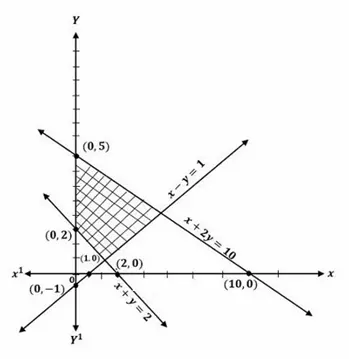
Let x denotes the number of heads in a simultaneous toss of three coins, then $P(0 < x \leq 3)$
If A is an invertible symmetric matrix, then A⁻¹ is
If $\vec{a} = 3\hat{i} - 6\vec{j} + \hat{k}$ and $\vec{b} = 2\hat{i} - 4\vec{j} + \lambda\hat{k}$ are such that $\vec{a} \parallel \vec{b}$, then $3\lambda + 2 =$