CUET UG Mathematics — Algebra previous year questions with solutions.
let $\vec{a}$ be a non-zero vector of magnitude '$a$' and $\lambda$ is a non-zero scalar, then $\lambda\vec{a}$ is a unit vector if
Let $|\vec{a}| = 5, |\vec{b}| = 2$ and $\vec{a}\cdot\vec{b} = 6$, then the value of $|\vec{a} \times \vec{b}|$ is equal to
If $P(A) = \frac{3}{10}$, $P(B) = \frac{2}{5}$ and $P(A \cup B) = \frac{3}{5}$ then the value of $P(B|A) + P(A|B)$ is:
For any vector $\vec{a}$, the value of $|\vec{a} \times \hat{i}|^2 + |\vec{a} \times \hat{j}|^2 + |\vec{a} \times \hat{k}|^2$ is equal to:
If the objective function z = 4x + 3y has maximum value on a line joining points (3, a) and (b, 2) where a > 0, b > 0 such that a - b = 2, then the maximum value of z is:
If the random variable X has the following probability distribution: | X | 0 | 1 | 2 | otherwise | |---|---|---|---|---| | P(X) | k | 3k | 5k | 0 | Match List-I with List-II | List-I | List-II | |---|---| | (A) k | (I) $\frac{13}{9}$ | | (B) E (X) | (II) $\frac{4}{9}$ | | (C) P (X ≤ 1) | (III) $\frac{8}{9}$ | | (D) P (1 ≤ X ≤ 2) | (IV) $\frac{1}{9}$ | Choose the correct answer from the options given below: 1. (A) - (II), (B) - (I), (C) - (IV), (D) - (III) 2. (A) - (IV), (B) - (I), (C) - (II), (D) - (III) 3. (A) - (IV), (B) - (II), (C) - (I), (D) - (III) 4. (A) - (III), (B) - (II), (C) - (I), (D) - (IV)
If $\vec{a} = 2\hat{i} - 3\hat{j} + \hat{k}$ and $\vec{b} = 2\hat{i} + \hat{j} - \hat{k}$, then which of the following statements is/are correct? (A) $\vec{a}$ and $\vec{b}$ are collinear (B) $\vec{a}$ and $\vec{b}$ are perpendicular (C) Angle between $\vec{a}$ and $\vec{b}$ is $\frac{\pi}{4}$ (D) $|\vec{a} + \vec{b}| = 2\sqrt{5}$ Choose the **correct** answer from the options given below:
In a Binomial distribution, the probability of getting a success is $\frac{3}{4}$ and the variance is $\frac{3}{8}$ then the probability of no success is:
If A and B are two matrices of order 2 × 2 such that A is a symmetric matrix and B is a skew-symmetric matrix, then:
The solution of $\frac{7x+12}{x-9} < 4$; $ \neq 9$ is:
The random variable X has the following probability distribution | X | 0 | 1 | 2 | 3 | |---|---|---|---|---| | P(X) | a | a | b | b | such that E(x²) = 2E(x), then the value of b is:
If $|\vec{a}| = a$, then the value of $|\vec{a} \times \hat{i}|^2 + |\vec{a} \times \hat{j}|^2 + |\vec{a} \times \hat{k}|^2$ is
If $\vec{a}$, $\vec{b}$ and $\sqrt{3}\vec{a} + \vec{b}$ are unit vectors, then the angle between $\vec{a}$ and $\vec{b}$ is:
If A and B are two distinct events such that P(A|B) = P(B|A), then which of the following is /are possible? (A) A= B (B) P (A) = P(B) (C) A ⊂ B but A ≠ B (D) A∩ B = ɸ Choose the correct answer from the options given below:
Consider the linear programming problem(LPP): *Minimize* $Z = x + y$ $x + 2y \leq 4,$ $3x + y \geq 3,$ $4x + 3y \geq 6,$ $x, y \geq 0.$ Which of the following is correct for the above linear programming problem (LPP): (A) The LPP has a bounded feasible region. (B) The LPP has a unique optimal solution. (C) The optimal value of the LPP exists at the point (3/2, 0) (D) The corner points of the feasible region are (3/2, 0), (3/5, 6/5), (2/5, 6/5) and (4, 0) Choose the **correct** answer from the options given below:
Two cards are drawn simultaneously at random from a well shuffled pack of 52 Cards. Let X be the random variable which denotes number of kings in the draw. Then the probability distribution of X is
The corner points of the bounded feasible region determined by a set of constraints (linear inequalities) are A(0, 5), B(3, 5), C(5, 0) and D(4, 1) and the objective function is z = $px$ + 2$qy$ where p,q > 0. The condition on $p$ and $q$ such that the maximum z occurs at B and D, is:
If A and B are symmetric matrices of the same order, then which of the following are true? (A) AB - BA is a skew symmetric matrix (B) AB is a symmetric matrix (C) AB is a scalar matrix (D) AB + BA is a symmetric matrix Choose the correct answer from the options given below:
If A and B are invertible matrices of the same order, then $(AB)^{-1}$ is equal to
If $x, y \in \mathbb{R}$ then match List-I with List-II | List-I | List-II | | --- | --- | | (A) $\vert x\vert < \vert y\vert $ | (I) iff $x^2 > y^2$ | | (B) $\vert x\vert > \vert y\vert $ | (II) iff $x^2 \le y^2$ | | (C) $\vert x\vert \le \vert y\vert $ | (III) iff $x^2 < y^2$ | | (D) $\vert x\vert \ge \vert y\vert $ | (IV) iff $x^2 \ge y^2$ | Choose the correct answer from the options given below:
A fair coin is tossed a fixed number of times. If the probability of getting 11 heads is equal to the probability of getting 13 heads, then the probability of getting 2 heads is:
For an LPP: Maximize $z = 3x + 9y$, $x \geq 0, y \geq 0$, the feasible region OAB is shown in the figure, then the other constraints are 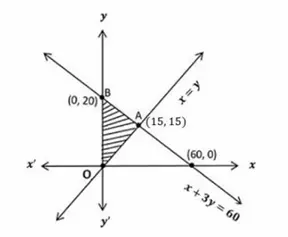
If A and B are independent events, then which of the following is/are true? (A) $\bar{A}$ and B are independent events (B) $P(A \cap B) = 0$ (C) $\bar{A}$ and $\bar{B}$ are independent events (D) $P(A \cap B) = P(A) + P(B)$ Choose the correct answer from the options given below:
Match List-I with List-II | List-I | List-II | | --- | --- | | (A) If vector $\vec{a}$ and $\vec{b}$ are such that $\vec{a} = \lambda \vec{b}$ and $\vert \vec{a}\vert = \vert \vec{b}\vert $, then | (I) $\vec{a}$ and $\vec{b}$ are orthogonal | | (B) Projection vector of $\vec{a}$ on $\vec{b}$ | (II) $[0, 12]$ | | (C) $\vec{a}$ and $\vec{b}$ are non-zero vectors such that $\vert \vec{a} + \vec{b}\vert = \vert \vec{a} - \vec{b}\vert $, then | (III) $\vec{a} = \pm \vec{b}$ | | (D) If $\vert \vec{a}\vert = 4, -3 \le \lambda \le 2$, then the range of $\vert \lambda \vec{a}\vert $ | (IV) $(\dfrac{\vec{a} \cdot \vec{b}}{\vert \vec{b}\vert ^2}) \vec{b}$ | Choose the correct answer from the options given below: