The distance of the point Q(0,2,–2) form the line passing through the point P(5,–4,3) and perpendicular to the lines =(-3 i+2 k)+λ (2 i+3 j+5 k),λ ∈…
JEE Main 2024 — Mathematics Vectors & 3D Geometry
2024mcqmedium
The distance of the point Q(0,2,–2) form the line passing through the point P(5,–4,3) and perpendicular to the lines r=(−3i^+2k^)+λ(2i^+3j^+5k^),λ∈R and r=(i^−2j^+k^)+μ(−i^+3j^+2k^),μ∈R is
Official previous-year question
Held on 31 Jan 2024 · Verified 6 Jul 2026.
Options
A
86
B
20
C
54
D
74
Did you get this right?
Sign in to track your attempts and accuracy.
Solution
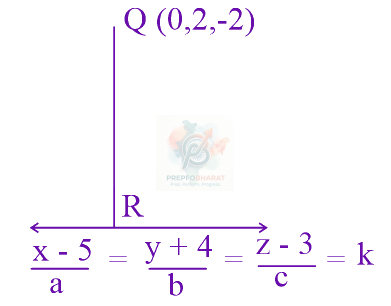
Plotting the diagram of the given data we get,
Now, let a,b,c be the DR's of the line perpendicular to (−3i^+2k^)+λ(2i^+3j^+5k^)and(i^−2j^+k^)+μ(−i^+3j^+2k^).
⇒2a+3b+5c=0,−a+3b+2c=0
Now, solving 2a+3b+5c=0&-a+3b+2c=0 we get,
⇒−9a=−9b=9c
⇒1a=1b=−1c
So, the equation will be,
⇒1x−5=1y+4=−1z−3...(i)
Let R be the foot of perpendicular from Q(0,2,−2)to(i).
⇒1x−5=1y+4=−1z−3=k
⇒x=k+5,y=k−4,z=−k+3
⇒R≡(k+5,k−4,−k+3)
So, DR's of QR are (k+5,k−6,5−k).
Now, using perpendicular condition we get,
⇒1(k+5)+1(k−6)+(−1)(5−k)=0
⇒k=2
⇒R≡(7,−2,1)
⇒QR=49+16+9
⇒QR=74
Your note
Sign in to keep a private note on this question. Nothing you write is ever public.