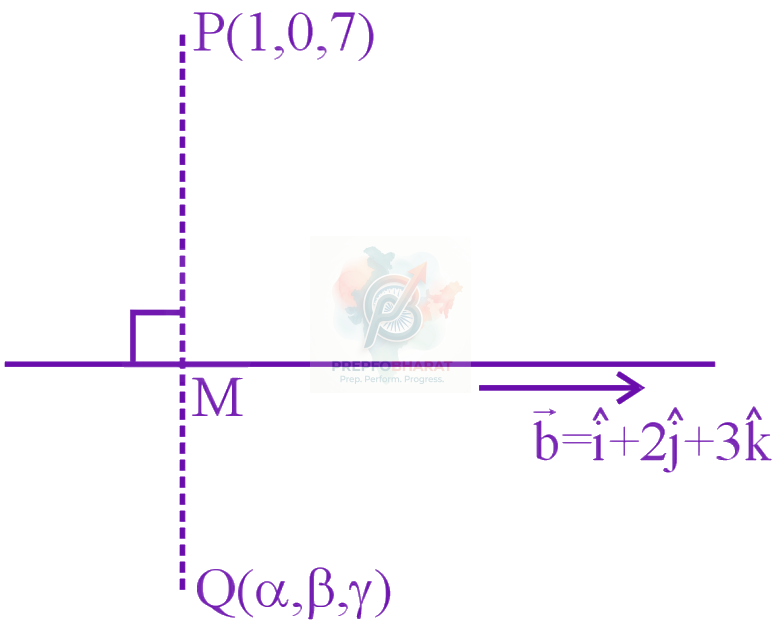
Let the image of the point (1,0,7) in the line x 1= y-1 2= z-2 3 be the point (α ,β ,γ ). Then which one of the following points lies on the line…
JEE Main 2024 — Mathematics Vectors & 3D Geometry
2024mcqmedium
Let the image of the point (1,0,7) in the line 1x=2y−1=3z−2 be the point (α,β,γ). Then which one of the following points lies on the line passing through (α,β,γ) and making angles 32π and 43π with y−axis and z−axis respectively and an acute angle with x−axis?
Official previous-year question
Held on 27 Jan 2024 · Verified 6 Jul 2026.
Options
A
(1,−2,1+2)
B
(1,2,1−2)
C
(3,4,3−22)
D
(3,−4,3+22)
Did you get this right?
Sign in to track your attempts and accuracy.
Solution
Given:
L1≡1x=2y−1=3z−2=λ
⇒M(λ,1+2λ,2+3λ)
⇒PM=(λ−1)i^+(1+2λ)j^+(3λ−5)k^
So, PM is perpendicular to line L1
⇒PM⋅b=0
⇒PM.b=[(λ−1)i^+(1+2λ)j^+(3λ−5)k^].(i^+2j^+3k^)
⇒λ−1+4λ+2+9λ−15=0
⇒14λ=14
⇒λ=1
⇒M=(1,3,5)
Now, M is midpoint of P and Q
⇒(1,3,5)≡(21+α,20+β,27+γ)
⇒21+α=1,2β=3,27+γ=5
⇒α=1,β=6,γ=3
Now, required line having direction cosine (l,m,n), where given m=\mathrm{cos}(\frac{-2\pi }{3})=\frac{-1}{2}&n=\mathrm{cos}(\frac{3\pi }{4})=\frac{-1}{\sqrt{2}}
Also, l2+m2+n2=1
⇒l2+(−21)2+(−21)2=1
⇒l2=41
⇒l=21
[Line make acute angle with x−axis]
So, the equation of line passing through (1,6,3) will be given by,
r=(i^+6j^+3k^)+μ(21i^−21j^−21k^)
Option (3)(3,4,3−22) satisfying for μ=4
Your note
Sign in to keep a private note on this question. Nothing you write is ever public.