Let a line L pass through the origin and be perpendicular to the lines L_1: =( i-11 j-7 k)+λ ( i+2 j+3 k),λ ∈ mathbbR and L_2: =(- i+ k)+μ (2 i+2 j+…
JEE Main 2023 — Mathematics Vectors & 3D Geometry
2023integermedium
Let a line L pass through the origin and be perpendicular to the lines L1:r=(i^−11j^−7k^)+λ(i^+2j^+3k^),λ∈R and
L2:r=(−i^+k^)+μ(2i^+2j^+k^),μ∈R. If P is the point of intersection of L and L1, and ,Q\alpha ,\beta ,\gamma is the foot of perpendicular from P on L2, then 9(α+β+γ) is equal to ________.
Official previous-year question
Held on 11 Apr 2023 · Verified 6 Jul 2026.
Did you get this right?
Sign in to track your attempts and accuracy.
Solution
Given,
A line L pass through the origin and be perpendicular to the lines L1:r=(i^−11j^−7k^)+λ(i^+2j^+3k^),λ∈R and
L2:r=(−i^+k^)+μ(2i^+2j^+k^),μ∈R
So, direction ratio of line will be,
∣i^12j^22k^31∣
=i^(−4)−j^(−5)+k^(−2)
=−4i^+5j^−2k^
Hence, the equation of line L which passes through origin will be,
L:r=σ(−4i^+5j^−2k^)
Now finding the intersection point P we get,
1+λ=−4σ....(1)
−11+2λ=5σ....(2)
−7+3λ=−2σ....(3)
So, from equation (1)&(3) we get, 1+λ=−14+6λ⇒λ=3,σ=−1
Hence, point P≡(4,−5,2)
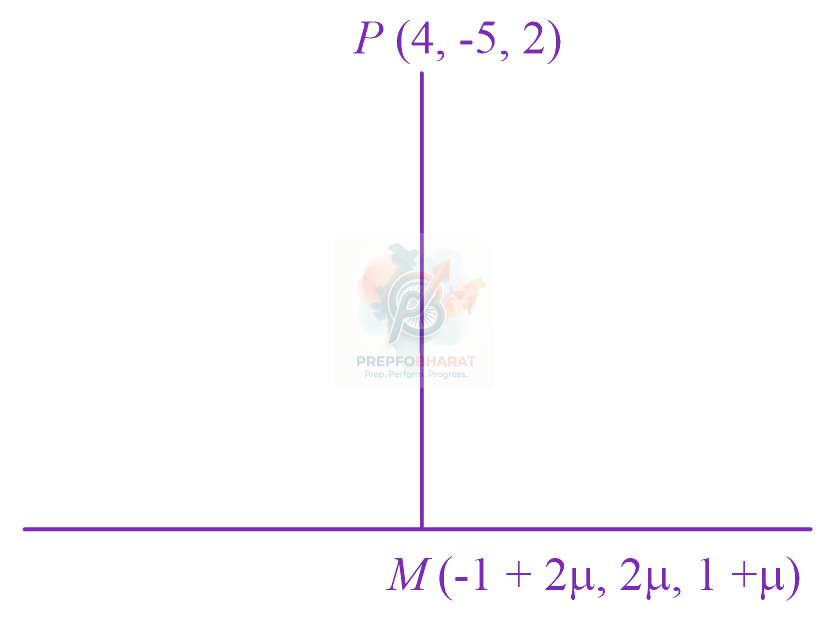
Now finding the point Q which is foot of perpendicular from point P(4,−5,2) on line L2:(−i^+k^)+μ(2i^+2j^+k^) we get,
Now any point on line L2 will be Q((2μ−1)i^+2μj^+(μ+1)k^)
Now direction ratio of PQ will be (−5+2μ)i^+(2μ+5)j^+(μ−1)k^=0
Now using the perpendicular condition we get,
2(−5+2μ)+2(2μ+5)+1(μ−1)=0
⇒μ=91
Hence, α+β+γ=2μ−1+2μ+μ+1=5μ=95
⇒9(α+β+γ)=5
Your note
Sign in to keep a private note on this question. Nothing you write is ever public.