The distance of the point having position vector - i+2 j+6 k from the straight line passing through the point (2, 3, -4) and parallel to the vector,…
JEE Main 2019 — Mathematics Vectors & 3D Geometry
2019mcqhard
The distance of the point having position vector −i^+2j^+6k^ from the straight line passing through the point (2,3,−4) and parallel to the vector, 6i^+3j^−4k^ is
Official previous-year question
Held on 10 Apr 2019 · Verified 6 Jul 2026.
Options
A
43
B
6
C
213
D
7
Did you get this right?
Sign in to track your attempts and accuracy.
Solution
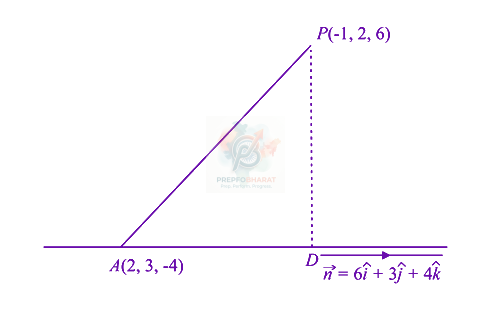
Let, the given point be P≡−i^+2j^+6k^ and A≡(2,3,−4), hence the position vector of the point A is 2i^+3j^−4k^.
We know that the vector joining two points (x1,y1,z1) and (x2,y2,z2) is (x2−x1)i^+(y2−y1)j^+(z2−z1)k^,
Hence, the vector AP=(−1−2)i^+(2−3)j^+(6+4)k^
⇒AP=−3i^−j^+10k^
And, AD is the projection of AP on the given line i.e. 6i^+3j^−4k^
We know that the projection of a vector a on a vector b is ∣b∣∣a⋅b∣
Hence, AD=∣n∣∣AP⋅n∣
⇒AD=62+32+(−4)2(−3i^−j^+10k^)⋅(6i^+3j^−4k^)
⇒AD=36+9+16∣−18−3−40∣
⇒AD=61 units
The distance between the points (x1,y1,z1) and (x2,y2,z2) is (x1−x2)2+(y1−y2)2+(z1−z2)2
Thus, AP=(−1−2)2+(2−3)2+(6+4)2=110 units
Now, in triangle ADP, by Pythagoras theorem, we have (AP)2=(PD)2+(AD)2
⇒PD=(AP)2−(AD)2=110−61=7 units.
Your note
Sign in to keep a private note on this question. Nothing you write is ever public.