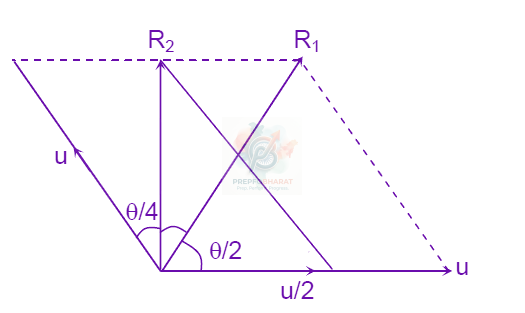
tan4θ=u+2ucosθ2usinθ ⇒sin4θ+21sin4θcosθ=21sinθcos4θ ∴2sin4θ=sin43θ=3sin4θ−4sin34θ ∴sin24θ=41⇒4θ=30∘ or θ=120∘
JEE Main 2006 — Mathematics Vectors & 3D Geometry
A particle has two velocities of equal magnitude inclined to each other at an angle θ. If one of them is halved, the angle between the other and the original resultant velocity is bisected by the new resultant. Then θ is
Held on 30 Apr 2006 · Verified 6 Jul 2026.
90∘
120∘
45∘
60∘
Sign in to track your attempts and accuracy.
Sign in to keep a private note on this question. Nothing you write is ever public.
Let $\hat{u}$ and $\hat{v}$ be unit vectors inclined at an acute angle such that $|\hat{u}\times\hat{v}|=\dfrac{\sqrt{3}}{2}$. If $\vec{A}=\lambda\hat{u}+\hat{v}+(\hat{u}\times\hat{v})$, then $\lambda$ is equal to:
Let $\vec{a}, \vec{b}, \vec{c}$ be three vectors such that $\vec{a} \times \vec{b}=2(\vec{a} \times \vec{c})$. If $|\vec{a}|=1,|\vec{b}|=4,|\vec{c}|=2$, and the angle between $\vec{b}$ and $\vec{c}$ is $60^{\circ}$, then $|\vec{a} \cdot \vec{c}|$ is equal to
If the distances of the point $(1,2, a)$ from the line $\frac{x-1}{1}=\frac{y}{2}=\frac{z-1}{1}$ along the lines $\mathrm{L}_{1}: \frac{x-1}{3}=\frac{y-2}{4}=\frac{z-a}{b}$ and $\mathrm{L}_{2}: \frac{x-1}{1}=\frac{y-2}{4}=\frac{z-a}{c}$ are equal, then $a+b+c$ is equal to
If the distance of the point $\mathrm{P}(43, \alpha, \beta), \beta<0$, from the line $\overrightarrow{\mathrm{r}}=4 \hat{i}-\hat{k}+\mu(2 \hat{i}+3 \hat{k}), \mu \in \mathbf{R}$ along a line with direction ratios $3,-1,0$ is $13 \sqrt{10}$, then $\alpha^{2}+\beta^{2}$ is equal to $\_\_\_\_$
Let $\overrightarrow{\mathrm{AB}}=2 \hat{i}+4 \hat{j}-5 \hat{k}$ and $\overrightarrow{\mathrm{AD}}=\hat{i}+2 \hat{j}+\lambda \hat{k}, \lambda \in \mathbb{R}$. Let the projection of the vector $\vec{v}=\hat{i}+\hat{j}+\hat{k}$ on the diagonal $\overrightarrow{\mathrm{AC}}$ of the parallelogram ABCD be of length one unit. If $\alpha, \beta$, where $\alpha>\beta$, be the roots of the equation $\lambda^{2} x^{2}-6 \lambda x+5=0$, then $2 \alpha-\beta$ is equal to
Work through every JEE Main Vectors & 3D Geometry PYQ, year by year.