Probability & Statistics PYQ — Page 2
JEE Main Mathematics — Probability & Statistics previous year questions with solutions.
All Probability & Statistics Questions (389)
Two distinct numbers $a$ and $b$ are selected at random from $1,2,3, \ldots, 50$. The probability, that their product $a b$ is divisible by 3, is
A letter is known to have arrived by post either from KANPUR or from ANANTPUR. On the envelope just two consecutive letters AN are visible. The probability, that the letter came from ANANTPUR, is:
Suppose that the mean and median of the non-negative numbers $21, 8, 17, a, 51, 103, b, 13, 67, (a > b)$, are $40$ and $21$, respectively. If the mean deviation about the median is $26$, then $2a$ is equal to:
The mean and variance of $n$ observations are $8$ and $16$, respectively. If the sum of the first $(n-1)$ observations is $48$ and the sum of squares of the first $(n-1)$ observations is $496$, then the value of $n$ is:
From the first 100 natural numbers, two numbers first $a$ and then $b$ are selected randomly without replacement. If the probability that $a-b \geqslant 10$ is $\frac{m}{n}, \operatorname{gcd}(m, n)=1$, then $m+n$ is equal to $\_\_\_\_$.
A coin is tossed $8$ times. If the probability that exactly $4$ heads appear in the first six tosses and exactly $3$ heads appear in the last five tosses is $p$, then $96p$ is equal to _____.
A random variable $X$ takes values $0,1,2,3$ with probabilities $\frac{2 a+1}{30}, \frac{8 a-1}{30}, \frac{4 a+1}{30}, b$ respectively, where $\mathrm{a}, \mathrm{b} \in \mathbf{R}$. Let $\mu$ and $\sigma$ respectively be the mean and standard deviation of X such that $\sigma^{2}+\mu^{2}=2$. Then $\frac{\mathrm{a}}{\mathrm{b}}$ is equal to :
A data consists of $20$ observations $x_1, x_2, \ldots, x_{20}$. If $\sum_{i=1}^{20}(x_i + 5)^2 = 2500$ and $\sum_{i=1}^{20}(x_i - 5)^2 = 100$, then the ratio of mean to standard deviation of this data is:
Let $\mathrm{X}=\{x \in \mathrm{~N}: 1 \leq x \leq 19\}$ and for some $a, b \in \mathbb{R}, \mathrm{Y}=\{a x+b: x \in \mathrm{X}\}$. If the mean and variance of the elements of Y are 30 and 750, respectively, then the sum of all possible values of $b$ is
A set of four observations has mean $1$ and variance $13$. Another set of six observations has mean $2$ and variance $1$. Then, the variance of all these $10$ observations is equal to:
A candidate has to go to the examination centre to appear in an examination. The candidate uses only one means of transportation for the entire distance out of bus, scooter and car. The probabilities of the candidate going by bus, scooter and car, respectively, are $\dfrac{2}{5}$, $\dfrac{1}{5}$ and $\dfrac{2}{5}$. The probabilities that the candidate reaches late at the examination centre are $\dfrac{1}{5}$, $\dfrac{1}{3}$ and $\dfrac{1}{4}$ if the candidate uses bus, scooter and car, respectively. Given that the candidate reached late at the examination centre, the probability that the candidate travelled by bus is:
Let \(x_1, x_2, \ldots, x_{10}\) be ten observations such that \(\sum_{i=1}^{10}\left(x_i-2\right)=30, \sum_{i=1}^{10}\left(x_i-\beta\right)^2=98, \beta\gt2\), and their variance is \(\frac{4}{5}\). If \(\mu\) and \(\sigma^2\) are respectively the mean and the variance of \(2\left(x_1-1\right)+4 \beta\), \(2\left(x_2-1\right)+4 \beta, \ldots ., 2\left(x_{10}-1\right)+4 \beta\), then \(\frac{\beta \mu}{\sigma^2}\) is equal to :
Given three indentical bags each containing 10 balls, whose colours are as follows : $\begin{array}{cccc} & \text{Red} & \text{Blue} & \text{Green} \\ \text{Bag I} & 3 & 2 & 5 \\ \text{Bag II} & 4 & 3 & 3 \\ \text{Bag III} & 5 & 1 & 4\end{array}$ A person chooses a bag at random and takes out a ball. If the ball is Red, the probability that it is from bag I is p and if the balls is Green, the probability that it is from bag III is q , then the value of $\left(\frac{1}{\mathrm{p}}+\frac{1}{\mathrm{q}}\right)$ is :
If the probability that the random variable X takes the value $x$ is given by $P(X=x)=k(x+1) 3^{-x}$, $\mathrm{x}=0,1,2,3 \ldots \ldots$, where k is a constant, then $\mathrm{P}(\mathrm{X} \geq 3)$ is equal to
The probability, of forming a 12 persons committee from 4 engineers, 2 doctors and 10 professors containing at least 3 engineers and at least 1 doctor, is:
Let $\mathrm{A}=\left[\mathrm{a}_{i j}\right]$ be a $2 \times 2$ matrix such that $\mathrm{a}_{i j} \in\{0,1\}$ for all $i$ and $j$. Let the random variable X denote the possible values of the determinant of the matrix $A$. Then, the variance of $X$ is :
A box contains 10 pens of which 3 are defective. A sample of 2 pens is drawn at random and let $X$ denote the number of defective pens. Then the variance of X is
A board has 16 squares as shown in the figure: 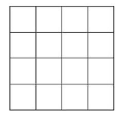 Out of these 16 squares, two squares are chosen at random. The probability that they have no side in common is :
Three defective oranges are accidently mixed with seven good ones and on looking at them, it is not possible to differentiate between them. Two oranges are drawn at random from the lot. If $x$ denote the number of defective oranges, then the variance of $x$ is
Let a random variable X take values $0,1,2,3$ with $\mathrm{P}(\mathrm{X}=0)=\mathrm{P}(\mathrm{X}=1)=\mathrm{p}, \mathrm{P}(\mathrm{X}=2)=\mathrm{P}(\mathrm{X}=3)$ and $\mathrm{E}\left(\mathrm{X}^2\right)=2 \mathrm{E}(\mathrm{X})$. Then the value of $8 \mathrm{p}-1$ is :
$A$ and $B$ alternately throw a pair of dice. $A$ wins if he throws a sum of 5 before $B$ throws a sum of 8 , and $B$ wins if he throws a sum of 8 before $A$ throws a sum of 5 . The probability, that $A$ wins if A makes the first throw, is
Bag 1 contains 4 white balls and 5 black balls, and Bag 2 contains $n$ white balls and 3 black balls. One ball is drawn randomly from Bag 1 and transferred to Bag 2. A ball is then drawn randomly from Bag 2. If the probability, that the ball drawn is white, is $29 / 45$, then $n$ is equal to :
All five letter words are made using all the letters $\mathrm{A}, \mathrm{B}, \mathrm{C}, \mathrm{D}, \mathrm{E}$ and arranged as in an English dictionary with serial numbers. Let the word at serial number $n$ be denoted by $W_n$. Let the probability $\mathrm{P}\left(\mathrm{W}_{\mathrm{n}}\right)$ of choosing the word $\mathrm{W}_{\mathrm{n}}$ satisfy $\mathrm{P}\left(\mathrm{W}_{\mathrm{n}}\right)=2 \mathrm{P}\left(\mathrm{W}_{\mathrm{n}-1}\right), \mathrm{n} \gt 1$. If $\mathrm{P}(\mathrm{CDBEA})=\frac{2^\alpha}{2^\beta-1}, \alpha, \beta \in \mathbb{N}$, then $\alpha+\beta$ is equal to : _______
Two balls are selected at random one by one without replacement from a bag containing 4 white and 6 black balls. If the probability that the first selected ball is black, given that the second selected ball is also black, is $\frac{m}{n}$, where $\operatorname{gcd}(m, n)=1$, then $m+n$ is equal to :