JEE Main Mathematics — Calculus previous year questions with solutions.
Let $\frac{dy}{dx}=\frac{ax-by+a}{bx+cy+a}$, where $a,b,c$ are constants. represent a circle passing through the point $(2,5)$. Then the shortest distance of the point $(11,6)$ from this circle is
The area of the region ${(x,y):|x-1|\leq y\leq \sqrt{5-{x}^{2}}}$ is equal to
Let $x=x(y)$ be the solution of the differential equation $2y{e}^{\frac{x}{{y}^{2}}}dx+({y}^{2}-4x{e}^{\frac{x}{{y}^{2}}})dy=0$ such that $x(1)=0$. Then, $x(e)$ is equal to
If $\frac{dy}{dx}+{e}^{x}({x}^{2}-2)y=({x}^{2}-2x)({x}^{2}-2){e}^{2x}$ and $y(0)=0$, then the value of $y(2)$ is
Let ${I}_{n}(x)={\int }_{0}^{x}\frac{1}{{({t}^{2}+5)}^{n}}dt,n=1,2,3,\ldots .$ Then
Let $\beta =\underset{x\rightarrow 0}{\mathrm{lim}}\frac{\alpha x-({e}^{3x}-1)}{\alpha x({e}^{3x}-1)}$ for some $\alpha \in \mathbb{R}$. Then the value of $\alpha +\beta$ is:
The number of distinct real roots of the equation ${x}^{5}({x}^{3}-{x}^{2}-x+1)+x(3{x}^{3}-4{x}^{2}-2x+4)-1=0$ is
The lengths of the sides of a triangle are $10+{x}^{2}$, $10+{x}^{2}$ and $20-2{x}^{2}$. If for $x=k$, the area of the triangle is maximum, then $3{k}^{2}$ is equal to
Let the solution curve $y=f(x)$ of the differential equation $\frac{dy}{dx}+\frac{xy}{{x}^{2}-1}=\frac{{x}^{4}+2x}{\sqrt{1-{x}^{2}}},x\in (-1,1)$ pass through the origin. Then ${\int }_{-\frac{\sqrt{3}}{2}}^{\frac{\sqrt{3}}{2}}f(x)dx$ is equal to
The sum of the absolute minimum and the absolute maximum values of the function $f(x)=|3x-{x}^{2}+2|-x$ in the interval $[-1,2]$ is
Let $y=y(x)$ be the solution curve of the differential equation $\mathrm{sin}(2{x}^{2}){\mathrm{log}}_{e}(\mathrm{tan}{x}^{2})dy+(4xy-4\sqrt{2}x\mathrm{sin}({x}^{2}-\frac{\pi }{4}))dx=0,0<x<\sqrt{\frac{\pi }{2}}$ , which passes through the point $(\sqrt{\frac{\pi }{6}},1)$. Then $|y(\sqrt{\frac{\pi }{3}})|$ is equal to _______.
Let $f:\mathbb{R}\rightarrow \mathbb{R}$ be a function defined as $f(x)=a\mathrm{sin}(\frac{\pi [x]}{2})+[2-x],a\in \mathbb{R}$, where $[t]$ is the greatest integer less than or equal to $t$. If $\underset{x\rightarrow -1}{\mathrm{lim}}f(x)$ exists, then the value of ${\int }_{0}^{4}f(x)dx$ is equal to
Let the solution curve $y=y(x)$ of the differential equation, $[\frac{x}{\sqrt{{x}^{2}-{y}^{2}}}+{e}^{\frac{y}{x}}]x\frac{dy}{dx}=x+[\frac{x}{\sqrt{{x}^{2}-{y}^{2}}}+{e}^{\frac{y}{x}}]y$ pass through the points $(1,0)$ and $(2\alpha ,\alpha ),\alpha >0$. Then $\alpha$ is equal to
Let $f(x)=2{\mathrm{cos}}^{-1}x+4{\mathrm{cot}}^{-1}x-3{x}^{2}-2x+10,x\in [-1,1]$. If $[a,b]$ is the range of the function, then $4a-b$ is equal to
$\underset{x\rightarrow \frac{\pi }{4}}{\mathrm{lim}}\frac{8\sqrt{2}-{(\mathrm{cos}x+\mathrm{sin}x)}^{7}}{\sqrt{2}-\sqrt{2}\mathrm{sin}2x}$ is equal to
The area of the smaller region enclosed by the curves ${y}^{2}=8x+4$ and ${x}^{2}+{y}^{2}+4\sqrt{3}x-4=0$ is equal to
If ${b}_{n}={\int }_{0}^{\frac{\pi }{2}}\frac{{\mathrm{cos}}^{2}nx}{\mathrm{sin}x}dx,n\in \mathbb{N}$, then
The value of ${\mathrm{log}}_{e}2\frac{d}{\mathrm{dx}}({\mathrm{log}}_{\mathrm{cos}x}cosecx)$ at $x=\frac{\pi }{4}$ is
The integral $\frac{24}{\pi }{\int }_{0}^{\sqrt{2}}\frac{(2-{x}^{2})\mathrm{dx}}{(2+{x}^{2})\sqrt{4+{x}^{4}}}$ is equal to ______.
If $n(2n+1){\int }_{0}^{1}{(1-{x}^{n})}^{2n}dx=1177{\int }_{0}^{1}{(1-{x}^{n})}^{2n+1}dx$, then $n\in N$ is equal to _______.
If $\underset{x\rightarrow 0}{\mathrm{lim}}\frac{\alpha {e}^{x}+\beta {e}^{-x}+\gamma \mathrm{sin}x}{x{\mathrm{sin}}^{2}x}=\frac{2}{3}$, where $\alpha ,\beta ,\gamma \in R$, then which of the following is NOT correct?
Let $f,g:R\rightarrow R$ be functions defined by $f(x)={\begin{matrix}[x] & ,x<0 \\ |1-x| & ,x\geq 0\end{matrix}$ and $g(x)={\begin{matrix}{e}^{x}-x, & x<0 \\ {(x-1)}^{2}-1, & x\geq 0\end{matrix}$ where $[x]$ denote the greatest integer less than or equal to $x$. Then, the function fog is discontinuous at exactly
Consider a curve $y=y(x)$ in the first quadrant as shown in the figure. Let the area ${A}_{1}$ is twice the area ${A}_{2}$. Then the normal to the curve perpendicular to the line $2x-12y=15$ does NOT pass through the point __ 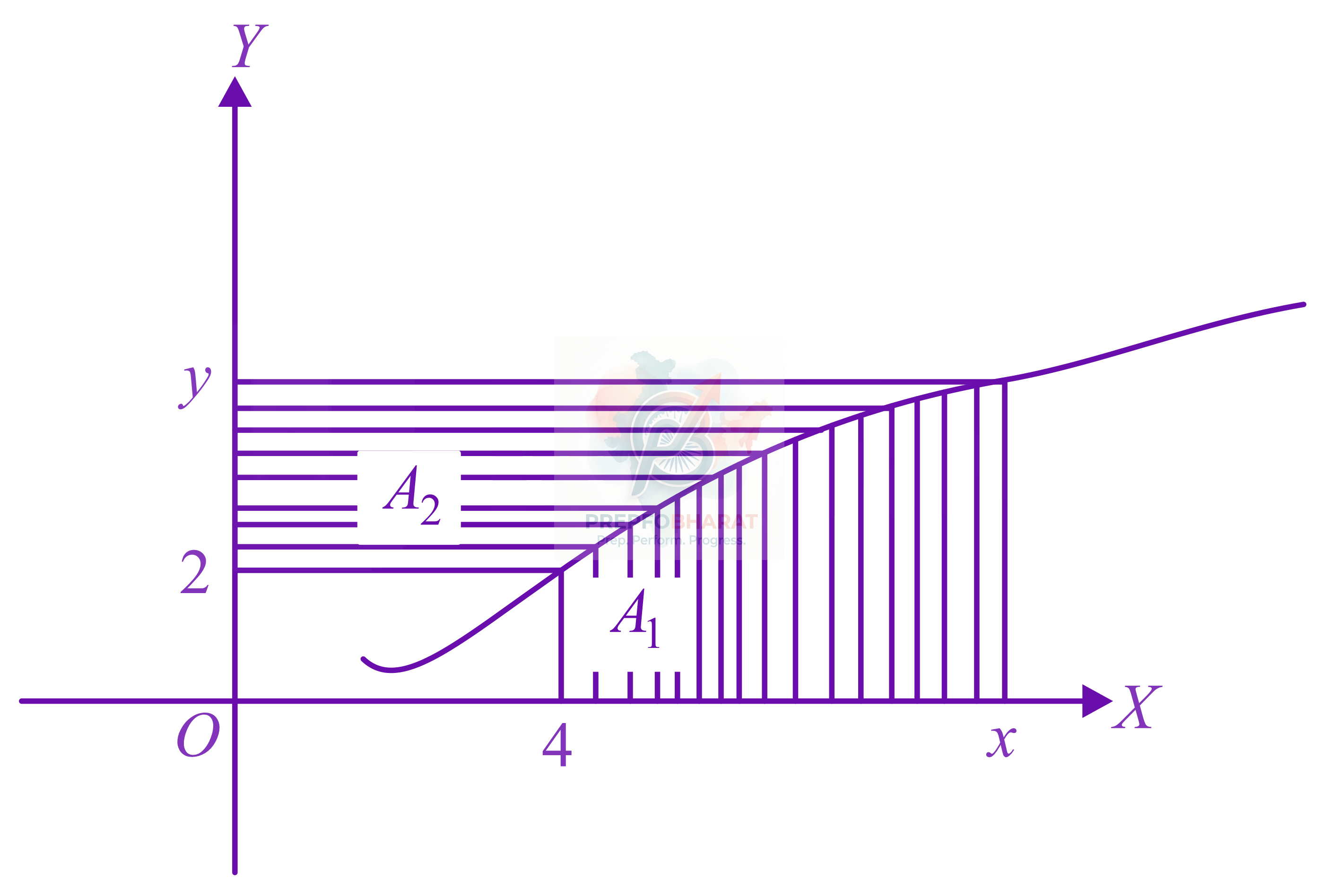
Let $f(x)$ be a polynomial function such that $f(x)+{f}^{'}(x)+{f}^{''}(x)={x}^{5}+64$. Then, the value of $\underset{x\rightarrow 1}{\mathrm{lim}}\frac{f(x)}{x-1}$ is equal to