JEE Main Mathematics — Algebra previous year questions with solutions.
Let p be the number of all triangles that can be formed by joining the vertices of a regular polygon P of n sides and q be the number of all quadrilaterals that can be formed by joining the vertices of $P$. If $p+q=126$, then the eccentricity of the ellipse $\frac{x^2}{16}+\frac{y^2}{n}=1$ is :
The number of ways, in which the letters $\mathrm{A}, \mathrm{B}, \mathrm{C}$, D, E can be placed in the 8 boxes of the figure below so that no row remains empty and at most one letter can be placed in a box, is : 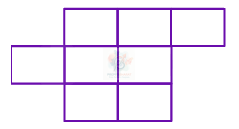
The number of 6-letter words, with or without meaning, that can be formed using the letters of the word MATHS such that any letter that appears in the word must appear at least twice, is _______.
If all the words with or without meaning made using all the letters of the word "KANPUR" are arranged as in a dictionary, then the word at $440^{\text {th }}$ position in this arrangement, is :
The sum $1+3+11+25+45+71+.$. upto 20 terms, is equal to
The number of words, which can be formed using all the letters of the word "DAUGHTER", so that all the vowels never come together, is
Let $\mathrm{x}_1, \mathrm{x}_2, \mathrm{x}_3, \mathrm{x}_4$ be in a geometric progression. $2,7,9,5$ are subtracted respectively from $x_1, x_2, x_3$ $x_4$ then the resulting numbers are in an arithmetic progression. Then the value of $\frac{1}{24}\left(x_1 x_2 x_3 x_4\right)$ is :
Let $a_1, a_2, \ldots, a_{2024}$ be an Arithmetic Progression such that $a_1+\left(a_5+a_{10}+a_{15}+\ldots+a_{2020}\right)+a_{2024}=2233$. Then $a_1+a_2+a_3+\ldots+a_{2024}$ is equal to _______
Let $a_1, a_2, a_3 \ldots$ be in an A.P. such that $\sum_{\mathrm{k}=1}^{12} \mathrm{a}_{2 \mathrm{k}-1}=-\frac{72}{5} \mathrm{a}_1, \mathrm{a}_1 \neq 0$. If $\sum_{\mathrm{k}=1}^{\mathrm{n}} \mathrm{a}_{\mathrm{k}}=0$, then n is:
For positive integers $n$, if $4 a_n=\left(n^2+5 n+6\right)$ and $S_n=\sum_{k=1}^n\left(\frac{1}{a_k}\right)$, then the value of $507 S_{2025}$ is :
$\text { In an arithmetic progression, if } S_{40}=1030 \text { and } S_{12}=57 \text {, then } S_{30}-S_{10} \text { is equal to : }$
Let $S_n=\frac{1}{2}+\frac{1}{6}+\frac{1}{12}+\frac{1}{20}+\ldots$ upto $n$ terms. If the sum of the first six terms of an A.P. with first term -p and common difference p is $\sqrt{2026 \mathrm{~S}_{2025}}$, then the absolute difference betwen $20^{\text {th }}$ and $15^{\text {th }}$ terms of the A.P. is
The sum of the series $2 \times 1 \times{ }^{20} \mathrm{C}_4-3 \times 2 \times{ }^{20} \mathrm{C}_5+4 \times 3 \times{ }^{20} \mathrm{C}_6-5 \times 4$ $\times { }^{20} \mathrm{C}_7+\ldots+18 \times 17 \times{ }^{20} \mathrm{C}_{20}$, is equal to
Let $z_1, z_2$ and $z_3$ be three complex numbers on the circle $|z|=1$ with $\arg \left(z_1\right)=\frac{-\pi}{4}, \arg \left(z_2\right)=0$ and $\arg \left(z_3\right)=\frac{\pi}{4}$. If $\left|z_1 \bar{z}_2+z_2 \bar{z}_3+z_3 \bar{z}_1\right|^2=\alpha+\beta \sqrt{2}, \alpha, \beta \in \mathbf{Z}$, then the value of $\alpha^2+\beta^2$ is :
If $7=5+\frac{1}{7}(5+\alpha)+\frac{1}{7^2}(5+2 \alpha)+\frac{1}{7^3}(5+3 \alpha)+\ldots \infty$, then the value of $\alpha$ is :
If the equation $\mathrm{a}(\mathrm{b}-\mathrm{c}) \mathrm{x}^2+\mathrm{b}(\mathrm{c}-\mathrm{a}) \mathrm{x}+\mathrm{c}(\mathrm{a}-\mathrm{b})=0$ has equal roots, where $\mathrm{a}+\mathrm{c}=15$ and $\mathrm{b}=\frac{36}{5}$, then $a^2+c^2$ is equal to
The largest $\mathrm{n} \in \mathrm{N}$ such that $3^{\mathrm{n}}$ divides 50 ! is:
Let the domains of the functions $\mathrm{f}(\mathrm{x})=\log _4 \log _3 \log _7\left(8-\log _2\left(\mathrm{x}^2+4 \mathrm{x}+5\right)\right)$ and $g(x)=\sin ^{-1}\left(\frac{7 x+10}{x-2}\right)$ be $(\alpha, \beta)$ and $[\gamma, \delta]$, respectively. Then $\alpha^2+\beta^2+\gamma^2+\delta^2$ is equal to :-
The product of all solutions of the equation $\mathrm{e}^{5\left(\log _{\mathrm{e}} x\right)^2+3}=x^8, x\gt0$, is :
Let $\alpha, \beta(\alpha \neq \beta)$ be the values of m , for which the equations $x+y+z=1 ; x+2 y+4 z=\mathrm{m}$ and $x+4 y+10 z=m^2$ have infinitely many solutions. Then the value of $\sum_{n=1}^{10}\left(n^\alpha+n^\beta\right)$ is equal to :
Let $f: R-\{0\} \rightarrow R$ be a function such that $f(x)-6 f\left(\frac{1}{x}\right)=\frac{35}{3 x}-\frac{5}{2}$. If the $\lim _{x \rightarrow 0}\left(\frac{1}{\alpha x}+f(x)\right)=\beta ; \alpha, \beta \in R$, then $\alpha+2 \beta$ is equal to
Let $f: \mathbb{R} \rightarrow \mathbb{R}$ be a function defined by $f(x)=(2+3 a) x^2+\left(\frac{a+2}{a-1}\right) x+b, a \neq 1 . \text { If }$ $f(x+\mathrm{y})=f(x)+f(\mathrm{y})+1-\frac{2}{7} x \mathrm{y}$, then the value of $28 \sum_{i=1}^5|f(i)|$ is
If $\sum_{r=1}^{30} \frac{r^2\left({ }^{30} C_r\right)^2}{{ }^{30} C_{r-1}}=\alpha \times 2^{29}$, then $\alpha$ is equal to ______
Let $\mathrm{A}=\left\{x \in(0, \pi)-\left\{\frac{\pi}{2}\right\}: \log _{(2 / \pi)}|\sin x|+\log _{(2 / \pi)}|\cos x|=2\right\}$ and $\mathrm{B}=\{x \geqslant 0: \sqrt{x}(\sqrt{x}-4)-3|\sqrt{x}-2|+6=0\}$. Then $\mathrm{n}(\mathrm{A} \cup \mathrm{B})$ is equal to :