CUET UG 2025 — Macro
Economics Macro questions from CUET UG 2025.
Other Years
581 Macro Questions from 2025
Match List-I with List-II | List-I | List-II | |---|---| | (A) Net National Product at Market Prices (NNP_MP) | (I) GNP_MP - Net Product Taxes - Net Production Taxes | | (B) Gross National Product at Market Prices (GNP_MP) | (II) GDP at market prices | | (C) Gross National Product at Factor Cost (GNP_FC) | (III) GNP_MP - Depreciation | | (D) GVA at Market Prices | (IV) GDP_MP + NFIA | Choose the correct answer from the options given below:
The change in the inventory of a firm is treated as an investment. What are the major categories of investment? (A) Investment Expenditure. (B) Autonomous Investment. (C) Fixed Business Investment. (D) Residential Investment. Choose the correct answer from the options given below:
Arrange the following chronologically: (A) Great Depression. (B) The Economic Consequences of the Peace. (C) An Enquiry into the Nature and cause of the Wealth of the Nations. (D) The General Theory of Employment, Interest and Money. Choose the correct answer from the options given below:
Match List-I with List-II | List-I | List-II | |---|---| | (A) C + I + G + (X-M) + NFIA | (I) $GDP_{MP}$ | | (B) $GDP_{MP}$ - Depreciation | (II) Domestic Income | | (C) NDP MP - IT + Subsidies | (III) $NDP_{MP}$ | | (D) $NDP_{MP}$ + Depreciation | (IV) $GNP_{MP}$ | Choose the correct answer from the options given below:
Match List-I with List-II | List-I | List-II | |---|---| | (A). M1 | (I). Currency held by the public and net demand deposits held by commercial banks | | (B). M2 | (II). M3 + Total deposits with Post Office savings organisations | | (C). M3 | (III). M1 + Net time deposits of commercial banks | | (D). M4 | (IV). M1 + Savings deposits with Post Office savings banks | Choose the correct answer from the options given below:
The current transfers from the rest of the world such as gifts, aids, etc. are included in ________.
Arrange the following statement considering the effects on total income and output when the government purchases (G) increase keeping taxes constant. (A). Planned aggregate expenditure will increase. (B). When G exceeds T, the government runs a deficit. (C). Equilibrium income will increase. (D). Aggregate demand schedule shifts rightward. Choose the correct answer from the options given below:
Which of the following is not an intermediate good?
Calculate Net National Product at factor cost (NNP$_{FC}$). 1. Rs. 3000 crores 2. Rs. 3137 crores 3. Rs. 3140 crores 4. Rs. 3500 crores
Arrange the following statements in chronological order with respect to open market operation. (A) Bonds payments increases total reserves in the economy. (B) RBI buys government bonds from the market. (C) RBI sell bond if there is excess money supply. (D) Higher reserves Increase money supply in the economy. Choose the correct answer from the options given below:
Goods & Services Tax (GST) is which of the following type of tax?
Revenue deficit in the government budget can be managed through:- (A) Borrowings from RBI. (B) Disinvestment. (C) Increasing Subsidy. (D) Borrowings from the general public. Choose the correct answer from the options given below:
In a simple economy, the circular flow between firms and households in terms of factor payments and services also represents as.
Foreign exchange reserves are ample, means? 1. Reserve is sufficient to purchase goods and services from abroad. 2. Anticipated demand for foreign goods and services can be met through incumbent foreign exchange reserve. 3. Supply of foreign reserves is more than demand of foreign reserves. 4. Government is confident about present and future need of foreign reserve.
What is GDP deflator?
During deficient demand, RBI __________ the margin.
Goods which are traded in large quantity and are not purchased by ordinary consumers. The price measure of such trading is known as .......
Identify from the following, the three functions that operate through the expenditure and receipts of the government are ......
With keeping tax rate (T) constant if government purchases(G) increase, then arrange the following statement considering the effect on total income and output. (A) Rise in Plan Aggregate expenditure. (B) Government runs a deficit when G exceeds T. (C) Equilibrium income level increased. (D) Aggregate demand schedule shifts upward. Choose the correct answer from the options given below:
In a hypothetical economy, the consumption function is given as C = 100 + 0.75Y. The autonomous investment in the economy is 200 crores. The equilibrium level of income would be______?
When the central bank intervenes to control the exchange rate through sell/purchase of foreign currencies, this process is called______
The process of Buying and selling of bonds issued by the Government by the central bank is called.
Which is the most commonly used measure of money supply?
"GST has improved India's ranking in terms of ease of doing business. The introduction of GST has attracted foreign investors in large numbers." What will be the sequential impact of the above on the exchange rate of the rupee in the international money market? (A) The supply curve of foreign exchange shifts to the right. (B) The exchange rate starts falling. (C) There is an appreciation of the rupee on the international money market. (D) An increase in foreign investment increases the supply of foreign exchange. Choose the correct answer from the options given below:
The bank rate and reserve money are the monetary tools of RBI to regulate the money flow with ........... 1. Cooperative banks 2. External banks 3. Central bank 4. Commercial banks
When the exchange rate of foreign currency increases due to managed floating rate it is known as_______.
A decrease in income of a country leads to?
A perfectly elastic aggregate supply curve implies that: (A) There is fuller utilization of resources in the economy. (B) There is unemployment of resources in the economy. (C) There is excess capacity in the economy. (D) Aggregate demand is less in the economy. Choose the correct answer from the options given below:
Match List-I with List-II | List-I | List-II | |---|---| | (A) An increase in proportional taxes | (I) Decreases consumption by MPC times the change in taxes. | | (B) An increase in lump-sum taxes | (II) Automatic Stabilizer. | | (C) Proportional income tax | (III) Aggregate demand curve shift inwards. | | (D) Lump sum taxes | (IV) Do not depend upon income. | Choose the correct answer from the options given below: 1. (A) - (I), (B) - (II), (C) - (III), (D) - (IV) 2. (A) - (I), (B) - (III), (C) - (II), (D) - (IV) 3. (A) - (III), (B) - (I), (C) - (II), (D) - (IV) 4. (A) - (III), (B) - (I), (C) - (IV), (D) - (II)
When goods and services are evaluated at constant prices, the measured value is known as ........
How much total credit creation can bank creates with Cash Reserve Rato of 20% when bank's reserves are Rs. 1000.
What is required to be subtracted from personal income in order to obtain personal disposable income?
Central Bank is a very important institution in a modern economy. Almost every country has one central bank. India got its central bank in ......
Any new addition to capital stock in an economy is measured by _________.
If the M1 in the economy is Rs 375 crores, net time deposits of commercial banks is Rs 250 crores and total deposits with post office savings organizations is Rs50 crores, then what will be M4?
The Reserve Bank sells foreign exchange when there is a deficit. This move of RBI is known by which of the following? 1. Official reserve sale. 2. Balance of payments deficit. 3. Balance of payments surplus. 4. Balance of trade.
The Central Bank is a very important institution in the modern economy. What are the main characteristics of the Reserve Bank of India? (A) India got its central bank in 1935. (B) It is the custodian of the foreign exchange reserves of the economy. (C) It controls the money supply of the country through various methods, like bank rate, open market operations etc. (D) It also acts as a bank for the banking system. Choose the correct answer from the options given below:
Which of the following are used to estimate GDP by expenditure method? (A) The final consumption expenditure on the goods and services produced by the firm. (B) The expenditure that the government makes on the final goods and services produced by firm. (C) Compensation of employees. (D) The final investment expenditure Choose the correct answer from the options given below:
The basis of the difference in income and product method of National Income Accounting is best deciphered by which of the following? 1. Product method measures the aggregate value of final goods and services produced by all the firms. 2. Income method measures the sum total of consumption expenditure. 3. Product method refers to the final consumption expenditure on the goods and services produced by the firm. 4. Income method refers to the fixed cost of the goods and services produced by the firm.
Full employment level is the level where ........
Exchange rate determined by the market forces of demand and supply is also known as...
From the following, which will be included in the National Income?
Given a cash reserve ratio of 50 per cent and reserves of Rs 100, what is the money multiplier?
Identify the correct statement from the following.
Arrange the statements in sequence of GDP composition on the expenditure side as per the annual report, Reserve Bank of India. (A) Gross Domestic Investment. (B) Private Final Consumption Expenditure. (C) Government Final Consumption Expenditure. (D) Net Exports. Choose the correct answer from the options given below:
Arrange the following as per the theory of the 'Paradox of Thrift': (A) Marginal Propensity to consume decreases. (B) Amount of savings decreases. (C) People become more thrifty. (D) Equilibrium level of income decreases. Choose the correct answer from the options given below: 1. (C), (A), (D), (B) 2. (A), (C), (B), (D) 3. (B), (A), (C), (D) 4. (C), (B), (A), (D)
M3 does not include which of the following?
There is a constitutional requirement in India to present before the Parliament a statement of estimated receipts and expenditures of the government in respect of every financial year which runs from............
Which of the following is not an advantage of GST?
From the following, find the right sequence for measuring National Income by Value Added Method: (A) Subtract the value of depreciation and net indirect taxes and add net factor income from abroad to arrive at national income. (B) Estimate the sum total value of output in the primary, secondary and tertiary sectors in the economy. (C) Estimate the value added of each sector by subtracting intermediate consumption from the value of output for every sector. (D) Calculate gross value added as the sum of value added of the three sectors.
Match List-I with List-II | List-I | List-II | |---|---| | (A) Ex-post investment | (I) AD function shifts upward | | (B) Investment multiplier | (II) Planned Investment + Unplanned Investment | | (C) Ex ante aggregate demand | (III) 1/1- MPC | | (D) Owing to increase in investment | (IV) $I = c + cY$ | Choose the correct answer from the options given below:
Excess demand is the situation where ......
For example, there is an increase in international travel by Indians. What will be the effect on the domestic currency? (A). Demand curve shifts upward and right to the original demand curve. (B). Demand for foreign goods and services increases. (C). Depreciation of domestic currency (rupees) in terms of foreign currency (dollars). (D). The value of rupees in terms of dollars has fallen and value of dollar in terms of rupees has risen. Choose the correct answer from the options given below:
Which of the following correctly defines Gross National Product at Market Prices (GNPMP)?
Suppose, a laptop has been purchased by Aman, a resident of Delhi from AX computers Pvt Ltd based in Gurugram, Haryana. Which type of GST will be levied on the laptop sold?
Which of the following can help to reduce the Fiscal Deficit?
Consider the following statement Net Investment = Rs. 5 Cr. Gross Investment = Rs 7.73 Cr. Find the value of Depreciation
Personal Disposable Income is? 1. The part of Aggregate Income which belongs to the household. 2. The part of Aggregate Income which belongs to the Government. 3. The part of Aggregate Income which belongs to the firm. 4. The part of Aggregate Income which belongs to the rest of the world.
What are the equilibrium conditions in the Keynesian model of income determination? (A) Aggregate demand = Aggregate supply. (B) Savings= Investment. (C) Consumption=Government Expenditure. (D) Planned Expenditure= Planned Output. Choose the correct answer from the options given below:
The index of prices of a given basket of commodities which are bought by the representative consumer is known as :
In the consumption equation, the slope of the consumption function is represented as:
Fiscal Responsibility and Budget Management Act (FRBMA) was framed in which year.
Which function of money helps in comparing the value of different goods and services?
Match List-I with List-II | List-I | List-II | |---|---| | (A) Inflationary gap | (I) A cause of deficiency of AD | | (B) Decline in exports | (II) A monetary measure to correct disequilibrium between AD and AS | | (C) Cash reserve ratio | (III) Pursued by the government of the country | | (D) Fiscal policy | (IV) There is no unemployment or underemployment in the country | Choose the correct answer from the options given below:
Arrange the following in ascending order in respect of evolution of money. (A) Coin exchanges. (B) Barter exchanges. (C) E-money. (D) Paper currency. Choose the correct answer from the options given below:
Match List-I with List-II | List-I | List-II | | --- | --- | | (A) Fixed period to maturity. | (I) Intrinsic Value | | (B) Currency notes and coins. | (II) M3 | | (C) Gold or silver coin. | (III) Time Deposits | | (D) Aggregate monetary resources. | (IV) Fiat Money | Choose the correct answer from the options given below:
The increase in income in an economy is four times more than the increase in investment. What is the value of marginal propensity to consume in this economy?
Identify the incorrect statement from the following.
Which of the following is not a characteristic of a capitalist economy?
Among the following identify the condition where firms face unplanned de-cumulation of inventories.
A banking service provided by a country is accounted in the element of the balance of payment.
The aggregate demand curve of an economy is parallel to X axis. What will be the value of investment multiplier in this economy?
The standard rate which is applied to the supply of goods and/or services across the country under the GST.
Which of the following is incorrect about accommodating transactions of the BoP?
What is required to be added to Net National Product at market prices to obtain National Disposable Income?
Given the equation of the consumption function as $C = \bar{C} + cY$, what does $\bar{C}$ donate?
The study of total output, employment and aggregate price level of an economy.
If aggregate demand falls after reaching full employment equilibrium, what will be the likely impact on the economy?
Identify the situation in which the equilibrium level of output is less than the full employment level of output?
In an Economy , total savings are rs. 2000 crores and the ratio of average propensity to save and average propensity to consume is 2: 7. Calculate the level of income in the economy?
Identify the correct statement from the following.
To obtain an estimate of borrowing on account of current expenditures exceeding revenues, we need to calculate what has been called the primary deficit. Gross primary deficit...
Arrange the following statements related to money multiplier process in correct sequence. (A) The bank has Rs 140 as deposits. (B) The bank has Rs 80 to lend. (C) A bank has a initial deposits of Rs 100 and needs to keep reserves as 20 per cent. (D) The bank lends 50% of lending amount to Sonia. Choose the correct answer from the options given below:
Identify the exchange rate system in which central bank of a country intervene to buy and sell foreign currencies in an attempt to moderate exchange rate movements whenever they feel that such actions are appropriate.
When aggregate output is determined solely by the level of aggregate demand, the relation between aggregate supply and price is?
Suppose there is a fresh deposit of Rs. 10,000 in banks and cash reserve ratio is 0.5. How much is total deposit creation? 1. 20,000 2. 50,000 3. 10,000 4. 5000
What does capital account of BOP record?
Which one is not the component of a aggregate demand for final goods?
Macroeconomics emerged as a separate subject in the year _________ due to Prof. J. M Keynes.
Goods and Services Tax became operational in the year:
Why GST is considered as unified tax system?
The well-being and wealth of the economy may not resonate only with possession of resources. It should ....................
When did the Government of India take a decision to demonetize the currency notes of Rs500 and Rs1000?
If all the people of the economy increase the proportion of income they save, the total value of savings in the economy will not increase - it will either decline or remain unchanged. This result is known as .......
In an economy if all individual increases the proportion of income they save, then arrange following statements in their chronological order. (A) Marginal propensity to consume decreases. (B) The level of income decreases. (C) The amount of savings remains the same. (D) The aggregate demand curve rotates downwards. Choose the correct answer from the options given below:
Arrange the given statement in terms of determining the ehange rate through a floating /flexible exchange rate. (A) Depreciation of domestic currency in terms of foreign currency. (B) The demand curve shifts upward and right to the original demand curve. (C) The demand for foreign goods and services increases. (D) The increase in demand for foreign goods and services result in a change in the exchange rate. Choose the correct answer from the options given below:
To measure consumer price index (CPI) which of the following years are taken into consideration? (A) Current Year. (B) Preceeding Year. (C) Base Year. (D) Succeeding Year. Choose the correct answer from the options given below:
Which one attracts both GST and Central Excise Duty?
When income is less than consumption, value of Average Propensity to Consume (APC) is.
If we have to pay Rs 150 for 3 pounds, then the exchange rate is Rs........... per pound.
A shock absorber which makes disposable income, and thus consumer spending, less sensitive to fluctuations in GDP is called.
Identify the net contribution made by a firm from the following : Domestic sales + Export + Change in stock - value of intermediate consumption.
Suppose, in a flexible exchange rate system, demand for foreign goods and services increases due to increased international travel by Indians. Arrange the following statements in correct sequence. (A) Exchange rate increases. (B) Exports from India become more affordable for foreigners. (C) India's income increases by keeping other factors constant. (D) The demand curve shifts towards the right. Choose the correct answer from the options given below: 1. (D), (B), (C), (A) 2. (D), (C), (B), (A) 3. (D), (A), (B), (C) 4. (D), (B), (A), (C)
The difference between the government's total expenditure and its total receipts excluding borrowing.
Match List-I with List-II | List-I | List-II | |---|---| | (A) Final goods market | (I) A + cY | | (B) Consumers demand | (II) ΔY/ΔA | | (C) Investment multiplier | (III) Ĉ + cY | | (D) Linear equation | (IV) a + bX | Choose the correct answer from the options given below:
Match List-I with List-II | List-I | List-II | |---|---| | (A) Marginal propensity to consume | (I) Change in savings per unit change in income. | | (B) Marginal propensity to save | (II) Savings per unit of income. | | (C) Average propensity to consume | (III) Change in consumption per unit change in income. | | (D) Average propensity to save | (IV) Consumption per unit of income. | Choose the correct answer from the options given below:
If the central bank wants to reduce the money supply in the economy, what it may do from the following? (A) Increase bank rate. (B) Reduce cash reserve ratio. (C) Increase in Repo Rate. (D) Buy securities in the open market. Choose the correct answer from the options given below:
Arrange the following events in chronological order as per the time period. (A) Gender Budgeting. (B) Fiscal Responsibility and Budget Management Act. (C) 101th Constitution Amendment Act. (D) Goods and Service Tax. Choose the correct answer from the options given below:
The difference between the value of exports and the value of imports of goods of a country in a given period of time is known as by what name?
Calculate Marginal Propensity to Save (MPS) and Average Propensity to Consume (APC) at income level of 200.
When the Reserve Bank of India was established?
Arrange the following steps of determination of equilibrium income in chronological order if C = 40 + 0.8Y, I = 10. (A) Y = C + I (B) 0.2Y = 50 (C) Y = 50 + 0.8Y (D) Y = 250 Choose the correct answer from the options given below: 1. (A), (B), (C), (D) 2. (A), (C), (B), (D) 3. (B), (A), (D), (C) 4. (C), (B), (D), (A)
Determination of income and employment of a two-sector model is done by: (A) Ex-ante aggregate demand for final goods. (B) Ex-post aggregate demand for final goods. (C) Fixed price of final goods. (D) Constant rate of interest. Choose the correct answer from the options given below:
The progressive taxation system seeks to achieve which of the following objectives of the government budget?
When goods and services are evaluated at some constant set of prices, it can also be defined as.
Chronologically arrange the following in sequence: (A) Smithsonian Agreement. (B) Gold standard system of exchange. (C) Gold was replaced by creating the Special Drawing Rights (SDR). (D) Bretton woods conference. Choose the correct answer from the options given below:
Identify the concept which should be deducted from the value of gross investment in order to accommodate regular wear and tear of capital goods. 1. Investment. 2. Capital 3. Depreciation 4. Consumption goods
If Multiplier is 2.5,how much investment will be required to generate additional income of 1000 crores?
________ is the ratio of the total increment in equilibrium value of final goods output to the initial increment in autonomous expenditure of the economy.
The ratio of increase in income to increase in investment is termed as
Which of the following is a quantitative tool of credit control by the reserve bank of India?
Match List-I with List-II | List-I | List-II | |---|---| | (A) Capital receipts | (I) Excess of total expenditure over and above all total receipts of the government | | (B) Corporate saving | (II) Borrowings of the government | | (C) Budget deficit | (III) Retained earnings of firm | | (D) Fiscal deficit | (IV) Create a liability for the government | Choose the correct answer from the options given below:
Savings are that part of income that is not consumed. What is the marginal propensity to save?
The value of the nominal GNP of an economy was Rs 5000 crores in a particular year. The value of GNP of that country during the same year, evaluated at the prices of same base year, was Rs 6000 crores. What is the value of the GNP deflator of the year.
If the current exchange rate is Rs. 80 to a pound and investors believe that the pound is going to appreciate by the end of the month and will be worth Rs.85, investors think if they gave the dealer Rs. 80,000 and bought 1000 pounds, at the end of the month, they would be able to exchange the pounds for Rs. 85,000, thus making a profit of ......
Mr. Kishore, an economics teacher, was explaining the concept of 'minimum percentage of total deposits to be kept by any commercial bank with the Central bank of the country, as per norms and statute prevailing in the country'. From the following, choose the correct alternative which specifies towards the concept explained by him:
Individuals or institutions that take economic decisions are known as................
Suppose the central bank of an economy records a net increase in the foreign exchange reserves for a given quarter. How will this be reflected in the balance of payments account of this economy?
Under __________ system, the central bank intervenes to buy and sell foreign currencies in an attempt to moderate exchange rate movements whenever they feel that such actions are appropriate.
Consumer Price Index (CPI) is measured by_______
An economy is facing inflationary pressures and the central bank of the country has been asked to control the situation. Arrange the action and result in sequential order. (A) Credit has become costlier and people stop borrowing. (B) Increase in Repo rate by the central bank. (C) Reduction in the money supply and aggregate demand falls. (D) Increase in the market lending rate by commercial banks. Choose the correct answer from the options given below:
Arrange the following economic events in chronological order: (A) Gold was displaced by creating the Special Drawing Rights (SDRs). (B) The Great Depression. (C) First World War. (D) Bretton Woods Conference. Choose the correct answer from the options given below:
Currency notes and coins cannot be refused by any citizen of the country for settlement of any kind of transaction due to which they are called __ __
Arrange the following steps in sequence for estimating GNPMP in a particular year through the income method. (A) Adding consumption of fixed capital and Net Indirect Taxes. (B) Classify the economy into primary, secondary and tertiary sectors. (C) Estimation of Factor income within domestic territory. (D) Adding Net factor income from abroad.
The priorities of the government in the fiscal area, examining current policies and justifying any deviation in important fiscal measures, are set under ..........statement. 1. Medium-term Fiscal Policy 2. The Fiscal Policy Strategy 3. The Macroeconomic Framework 4. Fiscal Responsibility and Budget Management Act
Rajesh is a weaver and is looking for food for his family. He approaches Shyam who is a farmer and offers to exchange clothes in return for wheat. However, Shyam says that his family needs shoes, not clothes. Which shortcoming of the barter system is being highlighted in this case?
The basic objective of macroeconomics is to develop theoretical tools. They are called........
It may be incorrect to treat GDP as an index of the welfare of the country for the following reasons. (A) Externalities. (B) Distribution of GDP is not uniform. (C) Monetary exchanges. (D) Non-monetary exchanges. Choose the correct answer from the options given below:
When the income of domestic consumers increases, their spending will Increase and thus spending on imported goods is also likely to increase. This leads to ............... of domestic currency?
An annual allowance for wear and tear of capital goods is defined as?
Which of the following is not a source of demand for foreign exchange in India?
What is the base year?
Match list I with List II in the context of the Government Budget: | List-I | List-II | |---|---| | (A) Purchase of stocks of a private company by the general government | (I) Capital receipts | | (B) Sale of equity of a public sector enterprise to private sector | (II) Revenue receipts | | (C) Payment of interest by the government on loans from financial institutions | (III) Capital expenditure | | (D) Stamp duty received by the government on property transactions in the country | (IV) Revenue expenditure | Choose the correct answer from the options given below:
If all the people in the economy increase the proportion of income they save, the total value of savings in the economy will not increase – it will either decline or remain unchanged. This situation is known as...................
Which are the following statements are true: (A) Open Market Operations refers to buying and selling of bonds issued by the Government in the open market. (B) Currency notes and coins are called fiat money. (C) M2 and M4 are known as broad money. (D) M1 and M2 are known as narrow money. Choose the correct answer from the options given below:
What was the immediate impact of demonetization on the economy?
A firm produces Rs 1000 worth of goods per year. Rs 200 is the value of intermediate goods used by it during the year and Rs 100 is the value of capital consumption. What is the net value of total production?
Match List-I with List-II | List-I | List-II | |---|---| | (A) Macroeconomics | (I) We study the behavior of aggregate measures of the performance of the economy. | | (B) Mixed economy | (II) All important decisions regarding production, exchange and consumption of goods and services are made by the government. | | (C) Market | (III) Some important decisions are taken by the government and the economic activities are by and large conducted through the market. | | (D) Centrally planned economy | (IV) A set of arrangements where economic agents can freely exchange their endowments or products with each other. | Choose the correct answer from the options given below: 1. (A) - (I), (B) - (III), (C) - (II), (D) - (IV) 2. (A) - (I), (B) - (II), (C) - (III), (D) - (IV) 3. (A) - (I), (B) - (III), (C) - (IV), (D) - (II) 4. (A) - (III), (B) - (IV), (C) - (I), (D) - (II)
The balance of payments records the transactions in goods, services and assets between residents of a country with the rest of the world for a specified time period. Identify the main accounts in the balance of payments.
If in an economy value of Net factor Income from Abroad is 200 cores and the Factor Income to Abroad is 40 crores. Identify the value of Factor Income from Abroad.
The study of macroeconomics usually simplifies the analysis of how the country's total ouput and the level of employment are related to.
Choose the correct statements: (A) Intermediate goods are used as raw materials or inputs for production of other commodities. (B) Consumer goods are consumed when purchased by their ultimate consumers. (C) Intermediate goods crossed production process boundary. (D) Capital goods have a durable character which are used in the production process.
The cost of a bag increased from $8 to $12 in the US and ₹ 400 to ₹480 in India. What affect it has on the dollar in respect to exchange price?
An increase in exchange rate implies that the price of foreign currency in terms of domestic currency has increased; this is called ........
Measure the level of ex-ante aggregate demand when autonomous investment and consumption expenditure (A) is Rs 80 crores, and MPC is 0.75.
Identify the correct reasons that may affect the demand for foreign exchange in an economy. (A) Import of visibles. (B) Export of invisibles. (C) Remittances by residents working abroad. (D) Purchase of assets abroad. Choose the correct answer from the options given below:
During the period of COVID, there was an apprehension that the Indian economy might slip into recession. Therefore, to combat the situation, the Reserve bank of India reduced the Repo rate by 110 basis points. Arrange the consequences of the same in sequential order. (A) Increase in aggregate demand. (B) Reduction in the market lending rate by commercial banks. (C) Increase in money supply. (D) Increase in borrowings by the public. Choose the correct answer from the options given below:
The excess of Government's Revenue Expenditure over Revenue Receipts is called............... 1. Revenue Deficit 2. Fiscal Deficit 3. Monetary Deficit 4. Primary Deficit
Calculate the value of operating surplus from following: Wages and Salaries Rs 2,000 Rent Rs 1,000 Interest Rs 500 Employers contribution in social security scheme Rs 200 Royalty Rs 300 Profits Rs 200
Choose the correct operation which will be adopted to arrive at GDP$_{MP}$ from NNP$_{MP}$.
Calculate Net Domestic Product at factor cost (NDP$_{FC}$). 1. Rs. 3000 crore 2. Rs. 3137 crore 3. Rs. 3140 crore 4. Rs. 3500 crore
Which of the following statements is correct with reference to the Cash Reserve Ratio (CRR)? A. The RBI decides a certain percentage of deposits which every bank must keep as reserves with the central bank B. To ensure that no bank is 'over lending' C. This is a legal requirement and is binding on the banks D. Cash Reserve Ratio and Statutory Liquidity Ratio are the same concept. Choose the correct answer from the options given below: 1. (A), (B) and (D) only 2. (A), (B) and (C) only 3. (A), (B), (C) and (D) 4. (B), (C) and (D) only
The saving function of a two sector economy is given as S=(-)100+0.2Y. The equilibrium level of income of this economy is 1000, then calculate the value of consumption at equilibrium?
Match List-I with List-II | List-I | List-II | |---|---| | (A) Primary deficit | (I) Net borrowing at home + Borrowing from RBI + Borrowing from abroad | | (B) Fiscal deficit | (II) Fiscal deficit – Net interest liabilities | | (C) Revenue deficit | (III) Revenue expenditure – Revenue receipts | | (D) Revenue Expenditure | (IV) Plan and non-plan expenditure | Choose the correct answer from the options given below:
Given that in an economy, consumption function is C = 80 + 0.80Y and autonomous investment (I) = 120, Match List-I with List-II | List-I | List-II | |---|---| | (A) Equilibrium level of income | (I) 400 | | (B) Break-even point | (II) 120 | | (C) Investment multiplier | (III) 5 | | (D) Value of savings at equilibrium | (IV) 1000 | Choose the correct answer from the options given below:
In which of the following method the flow is measured as the sum total of all factor payments?
Arrange the following central bank reserve rates in their descending rates. (A) Cash Reserve Ratio (B) Repo Rate. (C) Reverse Repo Rate. (D) Statutory Liquidity Ratio. Choose the correct answer from the options given below:
Under Article 246A, which was not enacted for GST?
There are two firms in an economy. Firm A gives Rs. 20 to the workers as wages, and keeps the remaining 30 as its profits. Similarly, firm B gives 60 as wages and keeps 90 as profits. Calculate GDP? 1. Rs. 200 2. Rs. 120 3. Rs. 50 4. Rs. 150
The purchase of war tanks by Indian government from Russia will be classified as
Match List-I with List-II | List-I | List-II | |---|---| | (A) $M_1$ | (I) $M_1$ + Net time deposits of commercial banks | | (B) $M_3$ | (II) Assets - Liabilities | | (C) Net Worth | (III) 1/CRR | | (D) Money Multiplier | (IV) Currency + Demand Deposit | Choose the correct answer from the options given below:
Arrange the given case study considering this process of ex-ante to ex-post investment. (A) At the end of the year, his inventory goes up by Rs 70 only (B) Due to an unforeseen upsurge in demand for his goods in the market, the volume of sales exceeds (C) The producer plans to add Rs 100 worth of goods to his stock by the end of the year, which is his planned investment (D) To meet this extra demand, he has to sell goods worth Rs 30 from his stock Choose the correct answer from the options given below:
Match List-I with List-II | List-I | List-II | |---|---| | (A) Effective demand | (I) National Income | | (B) Say's law of markets | (II) Aggregate demand exceeds aggregate supply at full employment | | (C) Inflationary gap | (III) Supply creates its own demand | | (D) Aggregate supply | (IV) Aggregate demand at equilibrium level | Choose the correct answer from the options given below:
Suppose a bank has an initial deposit of ₹200. The required cash reserve ratio is 20%. Then what will be the total money supply in an economy?
What is the role of official reserve account?
_____________ is the minimum level of consumption done at zero income level and is independent of income.
Why does central bank is called the lender of last resort? 1. It lends money to the government to finance its budget deficit. 2. Central bank lends money to trade and industry to support their export operations. 3. When a country runs out of money, the central bank prints more money. 4. Central bank lends money to banks at all times.
Put the alternatives given below in the sequence in which they occur to reach the equilibrium level of out put given that aggregate demand falls short of aggregate supply. (A) In this case, the firm has to run down existing inventories, which will lead to a fall in production and hence income. (B) Stocks will be piling up in the warehouses, causing unintended accumulation of inventories. (C) Ex- ante demand for final goods falls short of the output of final goods that the producers have planned to produce in a given year. (D) process continues till Ex- ante demand for final goods equals to ex -ante output of final goods Choose the correct answer from the options given below:
Match List-I with List-II | List-I | List-II | |---|---| | (A) Assets | (I) Create Credit | | (B) Liabilities | (II) Firm Owes to others | | (C) Central Bank | (III) Control Credit | | (D) Commercial Banks | (IV) Firm can Claim from others | Choose the correct answer from the options given below:
The General Theory of Employment, Interest and Money was published in......... and by ............. 1. 2025, Adam Smith. 2. 1935, John Maynard Keynes. 3. 1936, John Maynard Keynes. 4. 1932, David Ricardo.
Under this system, official reserve transactions are not equal to zero.
If aggregate demand changes, the equilibrium level of income changes. This can happen in any one or combination of the following situations: (A) Change in consumption. (B) Multiplier Effect. (C) Substitute Effect. (D) Change in Investment. Choose the correct answer from the options given below:
Arrange the following in chronological order. (A) Barter System (B) Currency notes (C) Precious metals (D) Online transfer of money. Choose the correct answer from the options given below: 1. (A), (B), (C), (D) 2. (A), (C), (B), (D) 3. (B), (A), (D), (C) 4. (C), (B), (D), (A)
At a given cash reserve ratio of 50% with deposits of ₹ 1000, the amount which can be used to give loans by the bank.
A country in the year 2000 produced 100 units of bread at price of Rs 10 per bread. GDP at current price was Rs 1,000. In 2001 the same country produced 110 units of bread at price Rs 15 per bread. What is the GDP deflator?
If the required reserve ratio in an economy is 12.5%, the initial cash deposits of ₹2000 will increase the money supply by ______.
In the short run, to determine the level of aggregate demand for final goods in the economy, what will be the affect on price and rate of interest?
In deficit condition of Balance of Payment if the central bank sells foreign exchange then this particular transaction is known as .......
Why did Monetary Policy Committee keep its policy rate unchanged in its recent meet?
When $C = 70 + 0.5Y$ and $I = 40$, what is the equilibrium income?
In the closed economy the ex ante aggregate demand for final goods is the sum total of:
Which among the following is not a direct participant in the foreign exchange market?
What is the principal motive for holding money?
Arrange the following steps of estimation of National Income by income method in the proper sequence. (A) Identification and classification of producing firms. (B) Estimation of NDPFC (C) Estimation of NNPFC (D) Classification of factor Income. Choose the correct answer from the options given below:
Which of the following are true about national income and related aggregates? (A) National income includes factor income earned from abroad but does not include factor income paid abroad. (B) Domestic income does not include factor income earned from abroad but includes factor income paid to abroad (C) Domestic income include both factor income earned from abroad and factor income paid to abroad (D) National income can never be smaller than domestic Income. Choose the correct answer from the options given below:
There may be times when demand exceeds available output under conditions of high employment and thus may give rise to inflation. In such situations, restrictive conditions may be needed to reduce demand. This intervention by the government is considered as
If the volume of imports of a country are growing faster than its volume of exports, its gross domestic product _______.
The Prime Minister of India, interacting with Pradhan Mantri Garib Kalyan Anna Yojana (PMGKY) beneficiaries, says that free ration has helped lakhs of poor during COVID pandemic. This is categorized as __________
Gifts, remittances and grants in current account are the components of ?
Goods and Service Tax, the single comprehensive indirect tax on all goods and services, extends the principle of one of the following
Suppose an Indian manufacturer of steel acquires a steel manufacturing unit in Europe. This type of transactions are recorded in which of the following.
When was the most recent demonetization undertaken by the government of India?
In order to arrive Gross Primary Deficit what should be deducted from Gross Fiscal deficit? 1. Borrowing from abroad 2. Net factor income from abroad 3. Net Interest liabilities. 4. Transfers payments
Which of the following are the functions of Government Budget? (A) Restriction. (B) Allocation. (C) Redistribution. (D) Stabilisation. Choose the correct answer from the options given below:
When nominal Gross Domestic Product is ₹840 crorer and price index is 120, then the Real Gross Domestic Product will be:
When an individual buys foreign goods, this spending is known as .....
Arrange the following events in chronological order according to time period. (A) The Economic Consequences of the Peace. (B) An Enquiry into the Nature and Cause of the Wealth of Nations. (C) The Great Depression. (D) General Theory of Employment, Interest and Money. Choose the correct answer from the options given below:
If India's current account balance is $-58$ million and the capital account balance is $62.5$ million. What will be the errors and omissions to have an overall balance in balance of payments?
Match List-I with List-II | List-I | List-II | |---|---| | (A) Capital formation | (I) Intermediate good | | (B) Money Supply | (II) Final good | | (C) Television purchased by a household | (III) Flow | | (D) Steel supply for car manufacturing | (IV) Stock | Choose the correct answer from the options given below:
Suppose an initial cash deposit of INR 100 crores has been made in a commercial bank where a total credit of INR 500 crores has been created in the economy. The required reserve ratio in this country is.............
When income increases and due to increase in income the demand for foreign goods increases then in this scenario what impact does economy face on foreign exchange rate ?
The ratio of nominal to real GDP refer to which economic concept?
If output equilibrium is less than the full employment level, then this condition is known as:
There is no leakage from the system then, in which form the entire income of the economy comes back to the producers?
The value of elements of the balance of payments are given as: Exports: $150$ million Imports: $240$ million Invisibles: $52$ million Non-factor Services: $30$ million Transfers: $32$ million What is the current account balance?
Which of the following best defines 'Unilateral Transfers' in the context of international transactions?
Arrange the following statement in the context of the effect of an autonomous change in aggregate demand on income and output. (A) When autonomous investment increases, the aggregate demand shifts in parallel upwards. (B) Equilibrium level of income depends on aggregate demand. (C) Excess demand emerges in the economy. (D) The output will be greater than the original output. Choose the correct answer from the options given below:
Match List-I with List-II | List–I | List–II | | ---------------------------------- | ----------- | | (A) Marginal propensity to consume | (I) ΔS/ΔY | | (B) Marginal propensity to save | (II) ΔC/ΔY | | (C) Average propensity to consume | (III) S / Y | | (D) Average propensity to save | (IV) C / Y | Choose the correct answer from the options given below:
Which of the following are stock variable(s)? (A) Population (B) Capital formation (C) Number of students in a school (D) Change in inventories Choose the correct answer from the options given below:
In an imaginary economy, the planned spending falls short of planned output at a certain level of employment. Arrange the following consequences of the same in sequential order. (A) Unintended accumulation of inventories. (B) The employment level falls. (C) The output and income fall and the equilibrium is restored. (D) Producers plan to produce less in the next period. Choose the correct answer from the options given below:
The RBI can influence money supply by changing the rate at which it gives long-term loans to commercial banks. This rate is called the...
A hypothetical economy tends to save only 25% of its additional income. How much additional income would be generated by it if the investment is increased by 50 crores?
Balance of Payments of an economy records.
______ level of income is that level of income where all the factors of production are fully employed in the production process.
Identify the correct sequence with regard to externalities: (A) Leads to negative externalities. (B) Production by the refining industry pollutes nearby rivers. (C) Causes harm to people. (D) Dependent may loose their livelihood. Choose the correct answer from the options given below:
How can a country reduce the BOP deficit?
The Indian government imports 22 Rafael planes from France. In which sub-account and on which side of the Balance of Payments account this transaction will be recorded?
Consumers will not voluntarily pay for what they can get for free and for which there is no exclusive title to the property being enjoyed. These non-paying users are known as....?
Other things remaining same, if the income abroad increases, what is the likely effect of the same on national income of the domestic economy?
When the marginal propensity to consume is given as $0.5$. What is the tax multiplier?
Who wrote the book "The Economic Consequences of the Peace"? 1. John Maynard Keynes 2. Adam Smith 3. J. S. Mill. 4. Alfred Marshall
The unsold finished goods, or semi-finished goods, or raw materials which a firm carries from one year to the next is a .....? 1. Flow and stock variable 2. Flow variable 3. Stock variable 4. Constant variable
Arrange the steps involved in preparation of the government budget. (A) Discussion and approval by the parliament. (B) Preparation of budget by the Ministry of Finance. (C) Implementation by the government. (D) Approval by the Cabinet. Choose the correct answer from the options given below:
In macroeconomics, when a price is constant, equilibrium is achieved at a point where?
Calculate the value of Real GDP for the year 2023 | Year | Output(units) | Market Price (in Rs) | |---|---|---| | 2022 | 150 | 10 | | 2023 | 200 | 20 |
What is change in price?
Arrange the following in correct sequence with respect to exchnage rate :- (A) The central bank purchases dollars to absorb the excess supply. (B) The exchange rate is fixed by the government higher than the market rate of exchange. (C) The government wants to encourage exports. (D) Supply of the dollars exceeds the demand for the dollar. Choose the correct answer from the options given below: 1. (B), (A), (D), (C). 2. (D), (A), (C), (B). 3. (C), (A), (D), (B). 4. (C), (B), (D), (A).
Arrange the following statements in the context of the calculation of Gross National Product at Market price. (A) Add Net factor income from abroad. (B) Calculate values of output. (C) Determine sales for the country. (D) Deduct intermediate consumption. Choose the correct answer from the options given below:
The interest rate paid by the commercial banks to depositors is lower than the rate charged from the borrowers. This difference between these two types of interest rates, called? 1. Bank Rate. 2. Spread. 3. Reserve. 4. Deposits.
When income is more than consumption, then value of Average Propensity to Save (APS) is.
Electronic transfer of money in terms of credit/ debit entries of the account-holders in the banks is called____.
Arrange the following steps in calculation of national income, by income method in correct sequence. (A) Add net factor income from abroad to arrive at national income. (B) Estimate the factor income paid by each sector. (C) Identify and classify the income generating units. (D) Calculating domestic factor income. Choose the correct answer from the options given below:
When a country exports more goods than its imports, the balance of trade is considered to be?
A current account deficit means that the nation is a borrower from other countries, which can also be represented as.
Calculate Gross Domestic Product at market price (GDP$_{MP}$). 1. Rs. 3500 crores 2. Rs. 3137 crores 3. Rs. 3140 crores 4. Rs. 3000 crores
The 'Ricardian equivalence' view argued that in the face of high deficits, people save more. It is called 'equivalence' because it argues that taxation and borrowing are equivalent means of ........... 1. Financing expenditure 2. Financing borrowing 3. Financing Taxation 4. Financing deficit
The value of nominal GDP is \$1100 and the value of real GDP is \$1000. Find the value of GDP deflator.
Arrange the following in correct sequence for calculating National Income. (A) Add Net Factor income from abaord. (B) Deduct value of Intermediate Goods. (C) Calculate the value of output. (D) Deduct Depreciation and NIT. Choose the correct answer from the options given below:
Who is the author of "The General Theory of Employment, Interest and Money"?
Graphically, Aggregate Demand (AD) function can be obtained by vertically adding the ________ and ________.
Consider the following statement related to investment: (A) The common notion is that investment is using money to buy physical or financial assets. (B) From an economist's view, investment is capital formation. (C) While measuring the final output, the portion which comprises capital goods, is the Gross Investment of an Economy. (D) The common and economic view regarding investment does not make any difference. It is the same. Choose the correct answer from the options given below: 1. (A), (B) and (C) only 2. (A), (B) and (D) only 3. (A), (B), (C) and (D) 4. (B), (C) and (D) only
Aggregate output is determined solely by the level of aggregate demand. This is known as effective demand principle. Which of the following is not the assumptions behind this principle?
If the government changes transfer payments ($\overline{TR}$), autonomous spending ($A$) will change by?
If a British resident wants to visit India on a vacation he will have to pay in ......
Money deposited in the banks are considered ______________ of the banks.
$C = 120 + 0.5Y$ $I = 20$ What is the equilibrium income?
Quantitative instruments of monetary policy focus on : (A) Quantity of money across selected sectors of the economy. (B) Overall supply of money in the economy. (C) Credit creation capacity of commercial banks. (D) Inflationary and deflationary gaps in the economy. Choose the correct answer from the options given below:
From the following find the statements related to GDP and the welfare of the economy (A) The domestic services that women perform at home are considered in the calculation of GDP. (B) Harmful effects caused due to carbon emissions from factory production are not counted as GDP. (C) The rise in GDP may be concentrated in the hands of very few individuals or firms. (D) Higher levels of GDP always ensure higher welfare. Choose the correct answer from the options given below:
When is Demonetisation, a new initiative was taken by the Government of India?
Among the following what are the functions of money? (A). Medium of exchange. (B). Unit of account. (C). Unit of purchasing power. (D). Store of value. Choose the correct answer from the options given below:
The decision of an individual economic agent is the study of ...................... ?
Match List-I with List-II | List-I | List-II | |---|---| | (A) An enquiry into the nature and cause of the wealth of nations | (I) 1919 | | (B) The Economic Consequences of the Peace | (II) 1929 | | (C) General Theory of Employment, Interest and Money | (III) 1776 | | (D) The Great Depression | (IV) 1936 | Choose the correct answer from the options given below:
Level of employment is determined by which of the following?
The cause of the above situation is?
Which of the following is not an autonomous transaction of the balance of payments?
Assume that the marginal propensity to consume is 0.8. The tax multiplier will then be ............... ?
From the given table, identify the level of income, where Average Propensity to Save (APS) becomes zero:
Arrange the following statements in chronological order in respect to the increase in the proportion of income people save. (A) Marginal propensity to consume decreases. (B) The level of income decreases. (C) The amount of savings remains the same. (D) The aggregate demand curve shifts downwards. Choose the correct answer from the options given below: 1. (A), (B), (C), (D) 2. (A), (C), (B), (D) 3. (B), (A), (D), (C) 4. (A), (D), (B), (C)
Machines produced in an economy in a given year are a part of ................
Which of the following does not lead to fall in Aggregate Demand?
Ex-post is depicted by which of the following ........
In case of an underemployment equilibrium, which of the following alternative is not true?
Identify which of the following is an example of non-debt capital receipts.
Which of the following is not an example of Net Invisible items? 1. Banking 2. Shipping 3. Machinery 4. Tourism
When governments intervene in the market to expand or reduce the demand, this course of action is .......
Which of the following are major functions of commercial banks?
International economic transactions are called ....... when transactions are made due to some reason other than to bridge the gap in the balance of payments, that is when they are independent of the state of balance of payments.
Aggregate demand for final goods consists which of the following? (A) Ex-ante consumption. (B) Ex-ante Investment. (C) Government spending. (D) Effective demand. Choose the correct answer from the options given below:
Value added refers to which of the following?
Among the following, which are the functions of money? (A) Medium of exchange. (B) Unit of account. (C) Bartering (D) Store of value Choose the correct answer from the options given below:
Match List-I with List-II | List-I | List-II | |---|---| | (A) Buying and selling of bonds | (I) Transaction Motive | | (B) Hold money is to carry out expenses | (II) Open Market Operations | | (C) The number of times a unit of money changes hands during the unit period | (III) Velocity of circulation | | (D) Hold money in terms of bonds | (IV) Speculative Motive | Choose the correct answer from the options given below:
Identify which of the following statements are correct? (A) Fiscal deficit is the difference between total revenue and total expenditure excluding borrowing of the government. (B) Fiscal deficit is the difference between total planned expenditure and total planned receipts of the government. (C) Primary deficit is the difference between total planned receipt and interest payments. (D) Fiscal deficit is the sum of primary deficit and interest payment. Choose the correct answer from the options given below:
Match List-I with List-II | List-I | List-II | |---|---| | (A) Macroeconomics | (I) Unlimited. | | (B) Human wants | (II) Economics of 'what ought to be'. | | (C) Normative Economics | (III) A system by which people of an area earn their living. | | (D) Economy | (IV) Studies the problem of choice at the level of the country as a whole. | Choose the correct answer from the options given below:
Level of planned output coincides with planned expenditure when: (AD = Aggregate Demand. AS= Aggregate Suplly)
A change in autonomous spending causes aggregate output of final goods to change by a large or small amount due to?
Consider the statements about Open Market Operations (OMO): (A) OMO is a tool by which the Reserve Bank of India(RBI) controls money supply. (B) OMO is an example of Qualitative Control. (C) Selling bonds through RBI reduces the money supply. (D) Outright OMOs are permanent in nature. Choose the correct answer from the options given below: 1. (A), (B), (C), (D) 2. Only (A), (B), (C) 3. Only (A), (C), (D) 4. Only (A), (D)
Which government body is responsible for reporting GDP in India ? 1. Department of Revenue 2. Central Board of Direct Taxes 3. Central Statistics Office 4. Niti Ayog
The place where currencies are traded is known as .........
Primary Deficit can be zero if?
If there is an increase in investment by Rs100 in an economy, MPC = 0.9, choose the correct sequence with reference to the working of the investment multiplier. (A) Producers increase their planned output further by (0.9)10, the income of the economy goes up by (0.9)10 and consumption demand increases further by (0.9)² 10. (B) This process goes on, round after round. (C) Income increases by 100, Consumption expenditure increases by 90 and therefore, aggregate demand goes up by 90. (D) The total increment in the income will be 1000. Choose the correct answer from the options given below:
The benefits (or harms) a firm or an individual causes to another for which they are not paid (or penalized) is referred to as .........
In a given consumption function C=50+0.5Y, autonomous consumption is.
The function of the investment multiplier is?
Which of the following indicate that the goods and services are evaluated at some constant set of prices ?
When did GST came in effect in India?
Match the following: | List -I | List -II | |---|---| | (A) Direct Investment | (I) Bilateral Loans | | (B) Portfolio Investment | (II) Equity Capital | | (C) External Borrowing | (III) Off Shore Funds | | (D) External Assistance | (IV) Short Term Debt | Which of the following combination is a correct match of the above? 1. (A) - (I), (B) - (II), (C) - (IV), (D) - (III) 2. (A) - (I), (B) - (II), (C) - (III), (D) - (IV) 3. (A) - (II), (B) - (III), (C) - (IV), (D) - (I) 4. (A) - (III), (B) - (IV), (C) - (I), (D) - (II)
The equilibrium level of output may be more or less than the full employment level of output. If it is less than the full employment of output, it is due to the fact that demand is not enough to employ all factors of production. This situation is called ......
Suppose the GDP at market price of a country in a particular year was Rs 2,100 crores. Depreciation was Rs 50 crores. The value of Indirect taxes was Rs 250 crores, Subsidies was Rs 150 crores and National Income was Rs 1250 crores. Calculate the aggregate value of net factor income from abroad.
In macroeconomic theory, which is not justification for taking the price level as fixed.
Arrange the following in order as per Income method of measuring national Income. (A) Classifying the production units into primary, secondary and tertiary sector on the basis of their occupational activities (B) Adding the net factor income from abroad. (C) Determination of domestic income. (D) Finding the factor payments made by each production unit and classifying it into compensation of employees, operating surplus and mixed income. Choose the correct answer from the options given below:
Arrange the following statements about the effect of an increase in taxes on total income and output. (A) An increase in taxes decreases disposable income. (B) Aggregate demand schedule shifts downwards. (C) Aggregate expenditure changes by a fraction of tax deduction. (D) Equilibrium output decreases.
The equilibrium level of income depends on aggregate demand. Thus, if aggregate demand changes, the equilibrium level of income changes. This can happen in anyone or combination of the following situations: (A) Change in autonomous consumption. (B) Change in marginal propensity to consume. (C) Income. (D) Change in autonomous investment. Choose the correct answer from the options given below:
Arrange the following statements when autonomous investment increases.. (A) The autonomous expenditure increases. (B) Aggregate demand and output have a multiplier effect. (C) Income and output increases. (D) The aggregate demand curve shifts parallel upward. Choose the correct answer from the options given below:
...... in which national currencies are traded for one another.
According to ___________, if the marginal propensity to save in the economy increases, the total value of saving in the economy will not increase.
It is difficult to record all international transactions accurately. Thus, there is a third element of Balance of Payment (BoP) (apart from the current and capital accounts) which adjusts inaccuracies to some extent that is called: 1. Reserves Change 2. Overall Balance 3. Errors and Omissions 4. Other Flows
Match List-I with List-II | List-I | List-II | |---|---| | (A) Real GDP | (I) Commodities traded in bulk. | | (B) Nominal GDP | (II) GDP evaluated at constant prices. | | (C) Consumer Price Index | (III) Commodities bought by representative consumers. | | (D) Wholesale Price Index | (IV) GDP evaluated at current market prices. | Choose the correct answer from the options given below: 1. (A) - (I), (B) - (II), (C) - (III), (D) - (IV) 2. (A) - (II), (B) - (IV), (C) - (III), (D) - (I) 3. (A) - (I), (B) - (IV), (C) - (III), (D) - (II) 4. (A) - (IV), (B) - (I), (C) - (III), (D) - (II)
When the interest rate is very high, newspapers and media channels are predicting that it may fall in future and hence anticipate capital gains from bond-holdings. Hence, people convert their money into bonds. In the above statement, which motive of money is highlighted? 1. Transaction Motive 2. Speculative Motive 3. Demonetisation Motive 4. Precautionary Motive
Match List-I with List-II | List-I | List-II | |---|---| | A. MPS | I. Saving Per unit of Income. | | B. MPC | II. Consumption per unit of Income | | C. APS | III. Change in consumption per unit change in income. | | D. APC | IV. Change in savings per unit change in income. | Choose the correct answer from the options given below: 1. (A) - (I), (B) - (II), (C) - (III), (D) - (IV) 2. (A) - (I), (B) - (III), (C) - (II), (D) - (IV) 3. (A) - (IV), (B) - (III), (C) - (I), (D) - (II) 4. (A) - (III), (B) - (IV), (C) - (I), (D) - (II)
When income increases, consumer spending increases. Spending on imported goods is also likely to __________. 1. Decrease. 2. Constant. 3. Increase. 4. Maybe an increase or maybe decrease.
Official reserve sale refers to 1. The reserve bank sells foreign exchange when there is a deficit. 2. The International Monetary Fund sells foreign exchange when there is a deficit. 3. Net consequences of autonomous transactions. 4. The agreement in which national currencies are traded for one another.
Which of the following statements is correct about commercial banks ? A. Considered as Money Creating system of the Indian Economy B. They accept deposits from the public at a lower interest rate and lend out part of these funds at a higher interest rate C. The difference between the interest rate paid to depositors and charged for lending is called "Spread". D. Commercial banks in isolation control the money supply in India. Choose the correct answer from the options given below: 1. (A), (B), (C) and D 2. (A), (B) and (D) only 3. (A), (B) and (C) only 4. (A) and (D) only
Gross Domestic Product at Market Price is the? 1. Gross Domestic Product at market price less net product taxes. 2. Market value of all final goods and services produced within a domestic territory of a country measured in a given financial year. 3. Expenditure to maintain the current GDP level. 4. Income earned by factors in the form of interest, profit, wages within the domestic territory of a country.
Trade deficits occur when
The headline inflation rate is largely under control, although the inflation rate for some specific food items is elevated. In the above statement, what is meant by control? 1. Within the range of the acceptable inflation rate. 2. Price rise of basic consumption item is not in control. 3. Price of items for daily consumption are growing in such a manner that they are manageable through implementing policy tools if need arises. 4. No price rise has been witnessed.
Match List-I with List-II | List-I | List-II | |---|---| | (A) Currency + Demand Deposits + Savings deposits with Post Office savings banks | (I) M4 | | (B) Currency + Demand Deposits + Net time deposits of commercial banks + Total deposits with Post Office | (II) M2 | | (C) Currency + Demand Deposits | (III) M3 | | (D) Currency + Demand Deposits + Net time deposits of commercial banks | (IV) M1 | Choose the correct answer from the options given below:
When a government action increases the exchange rate, by making the domestic currency cheaper, it is called..........
The issue of currency's credibility and ensuring stability in international transactions, is handled by ............
Which system is prone to speculative attack on a currency?
Which initiatives strengthened the government's resolution to go cashless. (A) Jan Dhan accounts. (B) Aadhar enabled payment systems. (C) E-Wallets. (D) National financial Switch. Choose the correct answer from the options given below:
Match List-I with List-II | List-I | List-II | |---|---| | (A) MPS | (I) $C/Y$ | | (B) MPC | (II) $\bar{C} + cY$ | | (C) APC | (III) $1 - c$ | | (D) Consumption function (C) | (IV) $\Delta C/\Delta Y$ | Choose the correct answer from the options given below:
Match List-I with List-II | List-I | List-II | |---|---| | (A) Not pass through any more stages of production or transformations | (I) Capital goods | | (B) Consumed when purchased by their ultimate consumers | (II) Intermediate goods | | (C) Gradually undergo wear and tear | (III) Final goods | | (D) Used by other producers as material inputs | (IV) Consumption goods | Choose the correct answer from the options given below:
The month in which the Goods and Services Tax became operational.
Which of the following is a stock variable?
What is the process through which banks create money?
Which of the following international transactions are meant to bridge the gap in BOP
Which of the following goods undergo wear and tear, thus gradually replaced over time?
Suppose in a hypothetical economy ,the income rises from ₹5000 crores to ₹6000 crores. As a result, the consumption expenditure rises from ₹4000 cores to ₹4600 crores. Then what will be the marginal propensity to consume?
Arrange the following in correct sequence according to their occurance. (A) Reduction in cash reserve ratio by the Reserve Bank. (B) Involuntary unemployment situation in the economy. (C) Increase in credit availability in the capital market. (D) Aggregate demand falls short of aggregate supply, corresponding to full employment in the economy. Choose the correct answer from the options given below:
Which is not a cause of disequilibrium in Balance of Payment?
Arrange the following in ascending order according to their year of implementation (A) The Smithsonian Agreement. (B) First World War. (C) Introduction of Liberalized Exchange Rate Management System. (D) The Bretton Woods Conference. Choose the correct answer from the options given below:
In which year, the book 'The Economic Consequences of the Peace' was written by John Maynard Keynes.
Identify which of the following is not included while estimating national income?
The ratio of the total increment in equilibrium value of final goods output to the initial increment in autonomous investment expenditure is known as?
In the balance of payments, the transactions of bonds and equity shares are placed under which of the following account?
Choose the correct statements from the following in respect of exchange rate system. (A) Floating Exchange Rate exchange rate is determined by the market forces of demand and supply. (B) In a fixed exchange rate system, making domestic currency cheaper is called Devaluation. (C) Increase in exchange rate implies that the price of foreign currency has increased and is called depreciation. (D) Exchange rates between any two currencies adjust to reflect differences in the price levels in the two countries. Choose the correct answer from the options given below:
Consider the following steps taken by the Reserve Bank of India with respect to money supply and arrange them in the appropriate sequence. (A) Increase in lending rates by commercial banks. (B) Contraction in credit. (C) Increase in bank rates by the Reserve bank of India. (D) Increase in cost of borrowings by commercial banks. Choose the correct answer from the options given below:
Suppose autonomous investment and consumption expenditure (A) in a hypothetical economy is ₹50 crores. MPS is 0.2 and the level of income is ₹4000 crores. The value of ex-ante aggregate demand would be _________
Identify which of the following statements is true about the final goods?
Which of the following is not correct for marginal propensity to consume?
Which of the following includes replacement investment?
Which of the following transaction is not included in national income?
Arrange the following steps in the correct sequence to explain the working of Multiplier. (A) Increase in income and consumption. (B) Increase in investment. (C) Rise in aggregate demand in each round (D) Generation of additional income. Choose the correct answer from the options given below:
Match List-I with List-II | List-I | List-II | |---|---| | (A) GDP at constant price | (i) known as Nominal GDP | | (B) GDP at current price | (ii) Increases only when there is increase in the quantum of output in the economy. | | (C) Welfare of the people | (III) known as earned income | | (D) Factor income | (IV) Measured in terms of the availability of goods and services | Choose the correct answer from the options given below:
Match List-I with List-II | List-I | List-II | |---|---| | (A) Capital consumption | (I) Value added | | (B) Part of raw material which gets used up | (II) Intermediate consumption | | (C) A stock variable | (III) Depriciation | | (D) A flow variable | (IV) Inventory | Choose the correct answer from the options given below:
Expenditure on the purchase of capital goods refers to ___________.
Instead of outright sale of securities, the Central Bank may sell securities through an agreement which has a specification about the date and price at which it will be repurchased. This type of agreement is called ________. The rate at which money is withdrawn in this manner is called________.
In an economy , the aggregate demand function is given by AD= 80 + 0.75 Y. What will be the value of investment multiplier?
Which of th following system is followed by the Reserve Bank of India for issuing currency?
Match List-I with List-II | List-I | List-II | |---|---| | (A) Secondary Deposits | (i) Initial deposits with commercial banks | | (B) Primary Deposits | (ii) The ratio of money held by the public in currency to that held at deposits in commercial banks. | | (C) Currency Deposit ratio | (iii) No intrinsic value | | (D) Fiat money | (iv) Demand deposits which come back to Commercial bank through lending process. | Choose the correct answer from the options given below:
What does the BOP record?
What could persistent current account deficit lead to?
By what value equilibrium output and aggregate demand will change, when the value of parameter c changes from 0.8 to 0.5 at a given A = 50?
Which statement is not true for M3 as a measure of money supply.
Match List-I with List-II | List-I | List-II | |---|---| | (A) Open Economy | (I) Equity and Bonds. | | (B) Financial Market | (II) Demand and supply of workforce. | | (C) Output Market | (III) Various economic avenues available. | | (D) Labor Market | (IV) Visible and Invisible Trade. | Choose the correct answer from the options given below:
Consider the following statement related to Aggregate Income (A) Aggregate revenue received by the firms is paid out to the factors of production it is considered as aggregate income. (B) Aggregate Income can be calculated by calculating the aggregate value of goods and services produced by the firms. (C) Income is being spent on the goods and services produced by the firms. It takes the form of aggregate expenditure received by firms. (D) Aggregate Income can not only be calculated through aggregate expenditure. There are other methods that exist. Which of the following combination of statements best explains the concept of Aggregate Income?
Net borrowing at home included which of the following?
Which of the following is the best example of Public provision and Public Production respectively?
The Fiscal Responsibility and Budget Management Act 2003 mandates the central government to lay before both houses of parliament. Which of the three statements along with the Annual Financial Statement?
Demonetization refers to :
Which of the following measures can be taken under fiscal policy to solve the problem of deficient demand in the economy?
Which of the following best explains the constitutional aspect of Goods and Services Tax implementation in India?
Which parameter does not determine the income and employment in the economy.
If the equilibrium level of output is more than the full employment level, it is due to the fact that the demand is more than the level of output produced at full employment level. This situation is called as.............
Which of the following statements about national debt are correct? (A) Deficit can be thought of as a flow variable which adds to the stock of debt (B) The government finances debt through taxation, borrowing or printing money (C) Debt owned to foreigners involves a higher burden than debt owned to domestic agents and institutions (D) Government's debt financing crowds out private borrowers in financial markets Choose the correct answer from the options given below:
Arrange the following statements in sequential order. (A) Aggregate demand will increase. (B) Induce the public to borrow more. (C) Central Bank will decrease the reverse repo rate. (D) Ex-ante aggregate demand is less than Ex-ante aggregate supply Choose the correct answer from the options given below: 1. (A), (B), (C), (D) 2. (A), (C), (B), (D) 3. (D), (C), (B), (A) 4. (A), (B), (D), (C)
Whatever is left over is appropriated by the entrepreneur is called .................. 1. Profit. 2. Interest. 3. Subsidies. 4. Capital.
How much consumption will increase when income increases by Rs. 5000 at given marginal propensity to consume of 0.60. 1. Increase in consumption= Rs. 5000 2. Increase in consumption= Rs. 4000 3. Increase in consumption= Rs. 3000 4. Increase in consumption= Rs. 2000
Which of the following are part of Capital account. (A) Foreign Direct Investment. (B) Offshore Funds. (C) Portfolio Investment. (D) Repayment of Loans. Choose the correct answer from the options given below: 1. (A), (B) and (D) only 2. (A), (B) and (C) only 3. (A), (B), (C) and (D) 4. (B), (C) and (D) only
In the consumption function $C = \bar{C} + cY$; autonomous consumption denoted by: 1. $C$ 2. $cY$ 3. $\bar{C}$ 4. $Y$
When the government has taken certain decision that can financed through the budget and can be used without any direct payment. Such move is known as.......... 1. Public Provision. 2. Public Production. 3. Public Goods. 4. Private Goods.
Match List-I with List-II | List-I | List-II | |---|---| | (A) Percentage of deposits that a bank keep as reserve with Central Bank | (I) Reserves + Loan. | | (B) Banks Assets | (II) Central Bank of a country. | | (C) Lender of the last Resort | (III) Aggregate Monetary Resources. | | (D) M₃ | (IV) Cash Reserve Ratio. | Choose the correct answer from the options given below: 1. (A) - (I), (B) - (II), (C) - (III), (D) - (IV) 2. (A) - (IV), (B) - (I), (C) - (II), (D) - (III) 3. (A) - (I), (B) - (II), (C) - (IV), (D) - (III) 4. (A) - (III), (B) - (IV), (C) - (I), (D) - (II)
When autonomous investment increases in a two-sector model, then. 1. The aggregate demand curve shifts upwards. 2. Output/GDP increases by the same magnitude as the change in investment. 3. Autonomous expenditure increases by the same magnitude as the change in investment. 4. The consumption curve shifts upwards.
Defense of the nation is a service provided by our armed forces. This service is. 1. Non -Public good which is non-rival and non excludable in consumption. 2. Public good which is non-rival and non excludable in consumption. 3. Non -Public good which is rival and non-excludable in consumption. 4. Public good which is rival and non-excludable in consumption.
Among the following, what is assumed as the appropriate justification for taking the price level as fixed? 1. An economy with unskilled workforce. 2. An economy having scarcity of resources. 3. An economy with excess use of resources. 4. An economy with unused resources.
From the following figure, how to obtain an aggregate demand function? 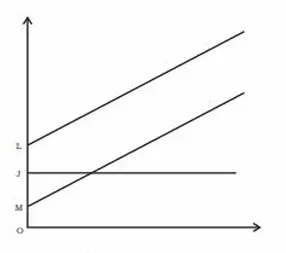
Which of the following approach measures economic activity by adding the aggregate value of final goods and services newly produced in a nation during a fixed period of time?
Calculate Operating surplus.
Which of the following statements is true about autonomous transactions?
Match List-I with List-II | List-I | List-II | |---|---| | (A) Marginal Propensity to Consume | (I) C/Y | | (B) Marginal Propensity to Save | (II) ΔC/ ΔY | | (C) Average Propensity to Save | (III) S/Y | | (D) Average Propensity to Consume | (IV) ΔS/ ΔY | Choose the correct answer from the options given below:
Which of the following statements are incorrect? (A) Loans from IMF is a Revenue Receipt. (B) Capital Receipts are shown on the liabilities of the balance sheet. (C) Interest payment by the government represents a representation of fiscal deficit. (D) Revenue Deficit is the excess of capital receipts over the revenue receipts. Choose the correct answer from the options given below:
Arrange the following steps in the calculation of national income, by income method in correct sequence: (A) Add Net Factor from Abroad to arrive at National Income. (B) Estimate the factor income estimated by each sector. (C) Identify and classify the income-generating units. (D) Calculate domestic factor income. Choose the correct answer from the options given below:
__________ refers to that level of aggregate demand, which can be met by the corresponding supply in the economy.
A cut in Repo Rate would lead to __________ in Money Supply and a cut in Reverse Repo Rate would lead to __________ in deposits of commercial bank to RBI
Repo Rate is the rate at which.
Arrange the following statements in sequential order. (A) Rise in prices. (B) Central Bank increases margin requirement. (C) Situation of excess demand in the economy. (D) Aggregate demand falls. Choose the correct answer from the options given below:
Suppose, following data is presented, for an imaginary economy: Autonomous Consumption = ₹ 100 crore Marginal Propensity to Consume = 0.6 Investment = 200 crore. Identify which of the following is the correct value of national income?
Which of the following is added in the estimation of national income?
Which of the following statements is true? If exchange rate changes from $1 = ₹85 to $1 = ₹90 (A) Imports will fall. (B) Imports will rise. (C) Exports will rise. (D) National income will rise. Choose the correct answer from the options given below:
Match List-I with List-II | List-I | List-II | |---|---| | (A) Annual financial statement | (I) Create liabilities or reduce financial assets. | | (B) Capital receipts | (II) Trade surplus. | | (C) Capital expenditure | (III) Main budget document. | | (D) Export > Import | (IV) Create financial assets or reduce liabilities. | Choose the correct answer from the options given below:
Kavish went to the supermarket with ₹5000 in his wallet to buy groceries for his family. He purchased vegetables, fruits and other household items, paying the respective prices at the counter. Which functions of money were being demonstrated in this real life scenario? (A) Unit of Labour. (B) Store of Value. (C) Medium of Exchange. (D) Measure of Creditworthiness. Choose the correct answer from the options given below:
Match List-I with List-II | List-I | List-II | |---|---| | (A) Bank Rate | (I) Securities are pledged in order to repurchase. | | (B) Open Market Operations | (II) Minimum rate at which funds are provided for long term. | | (C) Repo Rate | (III) Buying and selling of bonds issued by the government in open market. | | (D) Reverse Repo Rate | (IV) Central bank borrows funds from commercial banks. | Choose the correct answer from the options given below:
The measurement of Balance of Payments deficit is based on ___________ transactions.
The range of value of investment multiplier is always between _________ and _________.
Arrange the following steps of calculation of National income in sequence. (A) Deduction of intermediate cost (B) Estimation of value of output (C) Add net factor income from abroad (D) Deduction of depreciation and NIT Choose the correct answer from the options given below:
The current account is the record of trade in goods and services and transfer payments. Arrange the following components in terms of service. (A). Current account. (B). Net factor income + Net Non-factor income. (C). Net investment income + Net income from compensation of employees. (D). Trade in services. Choose the correct answer from the options given below:
Match List-I with List-II | List-I | List-II | | --- | --- | | (A) Gross Domestic Product at Market Price | (I) NDPMP - Net Product Taxes - Net Production Taxes | | (B) Net Domestic Product at Factor Cost | (II) GVA at basic prices - Net Production Taxes | | (C) GVA(Gross Value Added) at factor cost | (III) C+I+G+(X-M) | | (D) Gross National Product at Factor Cost | (IV) GNPMP - Net Product Taxes - Net Production Taxes | Choose the correct answer from the options given below:
Currency notes and coins are called:
The sales of bread have increased from 10 units to 15 units. Suppose the government imposed a unit tax of Rs. 5 on current production, then the total tax that the firm must pay to the government is?
From the following which product has been kept out from the GST ambit?
When autonomous investment increases, the aggregate demand curve shifts?
The aggregate demand function shows the total demand for goods and services at each level of income. The graphical representation of the aggregate demand function will have which of the following features? (A) It can be obtained by vertically adding the consumption and investment function. (B) It is parallel to the consumption function i.e., they have the same slope c. (C) It shows ex post demand. (D) It shows ex ante demand. Choose the correct answer from the options given below:
Match List-I with List-II | List-I | List-II | | --- | --- | | (A) Inventory | (I) Planned | | (B) Consumption | (II) Actually happened | | (C) Ex-ante | (III) Investment | | (D) Ex-post | (IV) Household Income | Choose the correct answer from the options given below:
To tackle the problem of corruption, black money, terrorism and the circulation of fake currency in the economy, demonetization was an initiative taken by the Government of India in the period?
Match List-I with List-II | List-I | List-II | | --- | --- | | (A) GNP$_{MP}$ - Depreciation | (I) NNP$_{MP}$ | | (B) GDP$_{MP}$ + NFIA | (II) GNP$_{MP}$ | | (C) NNP$_{MP}$ - Net Product Taxes - Net Production Taxes | (III) GDP$_{MP}$ | | (D) GVA$_{MP}$ | (IV) NNP$_{FC}$ | Choose the correct answer from the options given below:
Which one is not the component of capital receipts?
Even if income is zero, some consumption still takes place, which is independent of income. This type of consumption is called?
The government imposes taxes that do not depend on income, called?
Arrange the following money measures into their high to low liquid form. (A) M4 (B) M2 (C) M1 (D) M3 Choose the correct answer from the options given below:
Match List-I with List-II | List-I | List-II | |---|---| | (A) Current Account | (I) Receipts < Payments | | (B) Capital Account | (II) Net Investment Income. | | (C) Current Account Deficit | (III) Transfer Payment | | (D) Trade in Services | (IV) Portfolio Investment | Choose the correct answer from the options given below:
When the Reserve Bank of India buys government bonds from the market, how does that affect money supply in the economy?
The ratio of the total increment in equilibrium value of final goods output to the initial increment in autonomous expenditure is called:
Match List-I with List-II | List-I | List-II | |---|---| | (A) Net Worth | (I) Currency + Deposits | | (B) M₁ | (II) Reserves + Loans | | (C) Assets | (III) 1/ Cash Reserve Ratio | | (D) Money Multiplier. | (IV) Assets – Liabilities | Choose the correct answer from the options given below:
Any concept or saying, that describes the functioning of an imaginary economy is called ........
Identify the economic agents from the following. (A) Consumers. (B) Institutions like banks or corporations. (C) Producer. (D) Government. Choose the correct answer from the options given below:
Match List-I with List-II | List-I | List-II | |---|---| | (A) Public Provision | (I) No feasible way to deny anyone to use public goods. | | (B) Stabalisation Function | (II) Goods are produced directly by the government. | | (C) Non-Excludable | (III) Financed through the budget and can be used without any direct payment. | | (D) Public Production | (IV) Whether to expand demand or reduce it. | Choose the correct answer from the options given below:
From the following, identify the main features of Fiscal responsibility and Budget Management act. (A) The actual deficits may exceed the targets specified only on grounds of national security or natural calamity or such other exceptional grounds as the central government may specify. (B) The Act mandates the central government to take appropriate measures to reduce fiscal deficit to not more than 3 percent of GDP (C) The central government shall not borrow from the Reserve Bank of India except under specified conditions. (D) Measures to be taken to ensure greater transparency in fiscal operations. Choose the correct answer from the options given below:
Which of the following statements are true: (A) Average propensity to consume is the change in consumption per unit to change in income. (B) Ex-ante depicts what has been planned. (C) Ceteris paribus means 'other things remain equal'. (D) Ex-post depicts what has actually happened. Choose the correct answer from the options given below:
Match List-I with List-II | List–I | List–II | | --------------------------------------------------- | ------------------------------------------------------------------------------------------------------------------------------------------------------------------------------------------- | | (A) Gross Domestic Product at Market Prices (GDPₘₚ) | (I) All the economic output produced by a nation’s normal residents, whether they are located within the national boundary or abroad. | | (B) Net Domestic Product at Market Prices (NDPcₘₚ) | (II) Sum of income earned by all factors in the production in the form of wages, profits, rent and interest, etc., belonging to a country during a year. | | (C) Gross National Product at Market Prices (GNPₘₚ) | (III) All production done by the national residents or the non-residents in a country gets included, regardless of whether that production is owned by a local company or a foreign entity. | | (D) National Income (NI) | (IV) Income earned by the factors in the form of wages, profits, rent, interest, etc., within the domestic territory of a country. Choose the correct answer from the options given below: |
Match List-I with List-II | List–I | List–II | | ---------------- | ---------------------------------------------------------------------- | | (A) Devaluation | (I) Price of foreign currency in terms of domestic currency increase | | (B) Revaluation | (II) Price of domestic currency in terms of foreign currency increases | | (C) Depreciation | (III) Increase the exchange rate by the action of the Government | | (D) Appreciation | (IV) Decreases the exchange rate by the action of the Government | Choose the correct answer from the options given below:
Prices of a given basket of commodities which are bought by the representative consumer is indicated by which of the following? 1. Wholesale Price Index 2. Consumer Price Index 3. Market price 4. Commodity Price
The domestic services performed by women at home are categorized as: 1. Non-monetary exchanges 2. Externalities 3. Personal services 4. Social services
The intervention of the government, whether to expand demand or reduce it, constitutes the ............... function. 1. Public production 2. Allocation 3. Redistribution 4. Stabilisation
What are the main sources of demand in a closed economy? 1. Consumption, government spending, and domestic investment 2. Consumption, net exports and government spending 3. Consumption, government spending, domestic investment and net exports 4. Government spending, net exports and domestic investment
Choose the correct statements from the following. (A) Capital goods are those goods which are bought not for meeting immediate need of the consumer but for producing other goods. (B) Households refer to the families or individuals who supply factors of production to the firms and which buy the goods and services from the firms (C) Consumer Price Index is the index of prices of a given basket of commodity which are bought by the representative consumer (D) Wholesale Price Index refers to the percentage change in the weighted average price level.
The classification of money in terms of narrow and broad money is due to .....
Match List-I with List-II | List-I | List-II | |---|---| | (A) Interest received from abroad | (I) revenue expenditure | | (B) Partial repayment of loan | (II) capital expenditure | | (C) Selling of equity of PSUs by the government | (III) revenue receipt | | (D) Salaries given to government employees | (IV) capital receipt | Choose the correct answer from the options given below:
Suppose at the initial equilibrium of $Y^*$, there is an exogenous or autonomous shift in peoples' expenditure pattern – they suddenly become more thrifty. What will be the sequential effect of the above on the economy? (A) The sudden decline in MPC will imply a decrease in aggregate consumption spending and hence in aggregate demand. (B) There emerges an excess supply in the economy, but that would mean a reduction in factor payments in the next round and hence a reduction in income. (C) There is no change in the total value of savings. (D) MPS of the economy increases, and hence MPC falls. Choose the correct answer from the options given below:
Which of the following is not true about currency notes and coins?
If, in an economy, the minimum level of consumption is 45 and 80% of an increase in income(Y) is consumed, what will be the consumption function of this economy?
Match List-I with List-II | List-I | List-II | |---|---| | (A) Exchange Rate | (I) Supply of foreign exchange = Demand of foreign currency. | | (B) Gold standard system of exchange rate | (II) Domestic currency loses its value in relation to a foreign currency. | | (C) Par rate of exchange | (III) External value of the domestic currency. | | (D) Currency Depreciation | (IV) An old variant of fixed exchange rate. | Choose the correct answer from the options given below:
The investment multiplier is equal to which of the following?
Identify the correct statements from the following. (A) Borrowings are non-debt creating capital receipt. (B) Revenue deficit is same as borrowings of the government. (C) When a government spends more than it collects by way of revenue, it incurs a budget deficit. (D) The revenue deficit includes only such transactions that affect the current income and expenditure of the government. Choose the correct answer from the options given below:
Which of the following are the features of public goods?
Which of the following statement is true?
Which of the following is not a merit of the flexible exchange rate system?
A farmer produces cotton in his farm and sells it to the yarn making firm at Rs 2500. The yarn making firm sells this yarn to the cloth mill for Rs 4000, who make cloth from it and this cloth is sold to a readymade garments factory for Rs 6500. The ready made garments factory sells the garments to the retailer for Rs 9000 and makes a profit of Rs 2000. Assuming that the farmer does not incur any intermediate cost, what will be total value added in the above process?
Identify the correct expression to calculate equilibrium level of income of an economy.
Identify the objectives of government budget from the following. (A) Opening bank accounts of people. (B) Economic Stability. (C) Increase the employment rate in the economy. (D) Redistribution of income Choose the correct answer from the options given below:
Which of the following will be included in the domestic territory of India?
At the short run equilibrium of income and employment, __________.
Match List-I with List-II | List-I | List-II | |---|---| | (A) Average Propensity to Consume | (I) It is the savings per unit of income | | (B) Marginal Propensity to Consume | (II) It is the consumption per unit of income | | (C) Average Ppropensity to Save | (III) It is the change in savings per unit change in income | | (D) Marginal Propensity to Save | (IV) It is the change in consumption per unit change in income. | Choose the correct answer from the options given below:
Which of the following is a debt creating capital receipt of the government?
If for a hypothetical economy, the Net National Product at Factor cost is Rs 3580 crore, Net Indirect Taxes are Rs 35 crore and Net Current Transfers from the Rest of the World are Rs 240 crore, then what will be the value of National Disposable Income?
Which of the following is not true about GST in India?
Balance of payments of an economy is in surplus when__________
What was the negative impact of demonetization?
Which of the following is incorrect about the relaxations given by the government to reduce cash crunch immediately after demonetization?
Currency notes and coins are termed as ________.
If the central bank purchases the government securities from the commercial banks, it is likely to
Identify the incorrect feature in the context of GST.
Steel sheets are used for making automobiles and copper used for making utensils, what type of goods are these (Steel and Copper)?
Match List-I with List-II | List-I | List-II | |---|---| | (A) Marginal propensity to save | (I) Slope of consumption function | | (B) Marginal propensity to consume | (II) Value is 1 at the break even point of the economy | | (C) Investment Multiplier | (III) Reciprocal of marginal propensity to save | | (D) Average propensity to consume | (IV) 1- c | Choose the correct answer from the options given below:
At the present level of employment in a hypothetical economy, the aggregate demand is falling short of aggregate supply. What will be the likely change in the level of national income of this economy?
Under the fixed exchange rate regime, if the government of a country finds its currency to be overvalued and therefore deliberately reduces the value of its current against the foreign currency, it will be called as?
Which of the following items will be recorded in the capital account of the Balance of Payments account?
......... is the situation where the equilibrium level of output is less than the full employment of output.
If the National income of a country is ₹4000 million, the consumption of fixed capital is ₹200 million, Gross national product at market price is ₹5000 million and subsidies are ₹100 million, what will be the amount of Indirect taxes?
Match List-I with List-II | List-I | List-II | |---|---| | (A) GNP at Market price | (I) $GDP_{MP}$ + NFIA | | (B) GDP at Market price | (II) NI - Undistributed profits - Net interest payments made by households - Corporate tax + Transfer payments to the households from the government and firms | | (C) Personal income | (III) C + I + G + X - M | | (D) Private income | (IV) Factor income from net domestic product accruing to the private sector + National debt interest + Net factor income from abroad + Current transfers from government + Other net transfers from the rest of the world | Choose the correct answer from the options given below:
Which of the following products have been kept out of the ambit of GST for the time being?
Which of the following statements are true in macroeconomics? (A). GVA at factor costs + Net production taxes = GVA at basic prices. (B). GVA at basic prices + Net product taxes = GVA at market prices. (C). GNP ≡ GDP - Net factor income from abroad. (D). NNP ≡ GNP – Depreciation. Choose the correct answer from the options given below:
Economic exchanges without the mediation of money are referred to as ...........
Match List-I with List-II | List-I | List-II | |---|---| | (A). Gross Domestic Product at Market Prices (GDPMP) | (I). C + I + G + (X - M) | | (B). Gross Domestic Product at Factor Cost (GDPFC) | (II). GDPMP - Depreciation | | (C). Net Domestic Product at Market Prices (NDPMP) | (III). GDPMP - Net Product Taxes | | (D). Net Domestic Product at Factor Cost (NDPFC) | (IV). NDPMP - Net Product Taxes - Net Production Taxes | Choose the correct answer from the options given below:
Match List-I with List-II | List-I | List-II | |---|---| | (A). Marginal propensity to consume (MPC) | (I). C/ Y | | (B). Consumption function | (II). C + I | | (C). Average propensity to consume (APC) | (III). ΔC/ ΔY | | (D). Aggregate Demand | (IV). C = c + cY | Choose the correct answer from the options given below:
Budgetary deficits must be financed by either taxation, borrowing or printing money. Governments have mostly relied on borrowing, giving rise to......
A shock absorber which makes disposable income, and thus consumer spending, less sensitive to fluctuations in GDP is called......
What is the nominal GDP in 2021?
Consumption, investment and government spending are the major components of ......?
What is real GDP in 2021?
A decrease in autonomous spending causes aggregate output of final goods to .................... through the multiplier process.
Given a cash reserve ratio of 20 percent, reserves of Rs 100 create deposits of ___________?
Identify the major sectors in the domestic economy.
Arrange the following statements related to foreign exchange market (fixed exchange rate) in correct sequence. (A) RBI intervenes to purchase the dollars for rupees in the foreign exchange market in order to absorb this excess supply. (B) The government will fix a higher exchange rate by making the rupee cheaper for foreigners. (C) Supply of dollars exceeds the demand for dollars. (D) The Indian government wants to encourage exports. Choose the correct answer from the options given below:
Match List-I with List-II | List-I | List-II | |---|---| | (A) GDP_MP | (I) NNP_FC + NIT | | (B) GDP_FC | (II) NNP_MP - NIT | | (C) NNP_MP | (III) GDP_FC + NIT | | (D) NNP_FC | (IV) GDP_MP - NIT | Choose the correct answer from the options given below:
Among the following, which features are correct with regard to Revenue receipts. (A) Receipts that are redeemable. (B) Recurring receipts that do not lead to a claim on the government. (C) Receipts from different taxes. (D) Receipts that take into account the effects of tax proposals made in the finance bill. Choose the correct answer from the options given below:
Nation Income – Undistributed profits – Net interest payments made by households – Corporate tax + Transfer payments to the households from the government and firms, is ______
"General Theory of Employment, Interest and Money" by John Maynard Keynes was written in?
Which of the following study the aggregate effects of the forces of demand and supply in the markets?
Who among the following is called as the founding father of modern economics.
Which of the following represents the borrowing requirements of the government for the purposes other than interest payments?
Match List-I with List-II | List-I | List-II | |---|---| | (A) Non-monetary exchanges | (I) Can be positive or negative | | (B) Externalities | (II) Price Index | | (C) Per capita income | (III) Domestic services by housewives | | (D) GDP deflator | (IV) Total income/Population | Choose the correct answer from the options given below:
Deficient demand is said to exist in the economy when-
Which of the following statements is true about public goods? (A) Public goods are non rival in nature. (B) Public goods are non-excludable in nature. (C) Public goods may be produced by the government or the private sector. (D) Public goods and public production can be used interchangeably. Choose the correct answer from the options given below:
If the entire additional income is saved in an economy, the value of investment multiplier will be
The RBI can influence money supply by changing the rate at which it gives long term loans to the commercial banks. This rate is called?
Arrange the following in chronological order, starting from the earliest. (A) Publishing of 'An inquiry into the Nature and Cause of the Wealth of Nations'. (B) The Great Depression. (C) Publishing of 'The Economic consequences of the Peace'. (D) Publishing of 'General Theory of Employment, Interest and Money'. Choose the correct answer from the options given below:
A country whose aggregate demand grows faster than the rest of the world's normally finds its currency______.
In an economy, the consumption curve and saving curve are parallel to each other. What will be the value of investment multiplier in this economy?
Addition to the stock of physical capital and changes in the inventory of a producer is known as: 1. Asset Appreciation. 2. Consumption. 3. Stock. 4. Investment.
Addition to the stock of physical capital and changes in the inventory of a producer is known as .......
Which of the following are features of fiscal policy? (A) Taxes and government spending are tools of fiscal policy. (B) It is implemented by the central bank. (C) It influences aggregate demand. (D) It involves adjustments in public debt. Choose the correct answer from the options given below:
The government can change the distribution of income and bring about a distribution that is considered 'fair' by society. This policy decision is called ........
Identify the tax imposed by the government that do not depend on income.
Which of the following transactions will be recorded in the current account of Balance of Payment?
Currency of which denomination were newly launched during demonetization?
Under a flexible exchange rate, when the price of domestic currency in terms of foreign currency increases is called?
What happens to money supply if the RBI increases the cash reserve ratio?
Which of the following are included while calculating national income by expenditure method? (A) Expenditure on single-use producer goods purchased by firms. (B) Expenditure incurred by a private trust running an orphanage on the education of the children. (C) Expenditure incurred by the government on building dams and bridges across the nation. (D) Expenditure by foreigners on the final goods produced in the country. Choose the correct answer from the options given below:
The Reserve Bank of India publishes four measures of money supply. Which one of the measures is the least liquid in them?
Match List-I with List-II | List-I | List-II | |---|---| | (A) Expenditure method | (I) Invetory investment | | (B) Income method | (II) GDP in the phase of disposition | | (C) Value added method | (III) GDP in the phase of distribution | | (D) Value of output - sales | (IV) GDP in the phase of production | Choose the correct answer from the options given below:
Showing 500 of 581 questions.