NEET UG 2011 — Waves & Oscillations
Physics Waves & Oscillations questions from NEET UG 2011.
Other Years
6 Waves & Oscillations Questions from 2011
Two waves are represented by the equations $y_1=a \sin (\omega t+k x+0.57) \mathrm{m}$ and $y_2=a \cos (\omega t+k x) \mathrm{m}$, where $x$ is in metre and $t$ in second. The phase difference between them is
Two particle are oscillating along two close parallel straight lines side by side, with the same frequency and amplitudes. They pass each other, moving in opposite directions when their displacement is half of the amplitude. The mean positions of the two particles lie on a straight line perpendicular to the paths of the two particles. The phase difference is
Sound waves travel at $350 \mathrm{~m} / \mathrm{s}$ through a warm air and at $3500 \mathrm{~m} / \mathrm{s}$ through brass. The wavelength of a $700 \mathrm{~Hz}$ acoustic wave as it enters brass from warm air
A particle of mass $m$ is released from rest and follows a parabolic path as shown. Assuming that the displacement of the mass from the origin is small, which graph correctly depicts the position of the particle as a function of time? 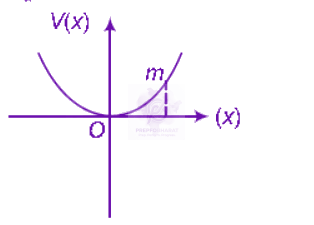
Two identical piano wires kept under the same tension $T$ have a fundamental frequency of $600 \mathrm{~Hz}$. The fractional increase in the tension of one of the wires which will lead to occurrence of 6 beat/s when both the wires oscillate together would be
Out of the following functions representing motion of a particle which represents SHM I. $y=\sin \omega t-\cos \omega t$ II. $y=\sin ^3 \omega t$ III. $y=5 \cos \left(\frac{3 \pi}{4}-3 \omega t\right)$ IV. $y=1+\omega t+\omega^2 t^2$