JEE Main Mathematics — Calculus previous year questions with solutions.
Let $f(x)$ be a cubic polynomial with $f(1)=-10,f(-1)=6,$ and has a local minima at $x=1,$ and ${f}^{'}(x)$ has a local minima at $x=-1.$ Then $f(3)$ is equal to .
Let $a$ be a real number such that the function $f(x)=a{x}^{2}+6x-15,x\in R$ is increasing in $(-\infty ,\frac{3}{4})$ and decreasing in $(\frac{3}{4},\infty )$. Then the function $g(x)=a{x}^{2}-6x+15,x\in R$ has a
If a rectangle is inscribed in an equilateral triangle of side length $2\sqrt{2}$ as shown in the figure, then the square of the largest area of such a rectangle is _____. 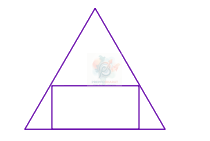
If ${y}^{1/4}+{y}^{-1/4}=2x,$ and $({x}^{2}-1)\frac{{d}^{2}y}{d{x}^{2}}+\alpha x\frac{dy}{dx}+\beta y=0,$ then $|\alpha -\beta |$ is equal to _______.
Let $f(x)=3{\mathrm{sin}}^{4}x+10{\mathrm{sin}}^{3}x+6{\mathrm{sin}}^{2}x-3$, $x\in [-\frac{\pi }{6},\frac{\pi }{2}]$. Then, $f$ is :
Let $y=y(x)$ be a solution curve of the differential equation $(y+1){\mathrm{tan}}^{2}xdx+\mathrm{tan}xdy+ydx=0$, $x\in (0,\frac{\pi }{2})$. If $\underset{x\rightarrow {0}^{+}}{\mathrm{lim}}xy(x)=1$, then the value of $y(\frac{\pi }{4})$ is:
The area (in sq. unit) bounded by the curve $4{y}^{2}={x}^{2}(4-x)(x-2)$ is equal to
Let $[t]$ denote the greatest integer $\leq t.$ Then the value of $8\cdot {\int }_{-\frac{1}{2}}^{1}([2x]+|x|)dx$ is
A box open from top is made from a rectangular sheet of dimension $a\times b$ by cutting squares each of side $x$ from each of the four corners and folding up the flaps. If the volume of the box is maximum, then $x$ is equal to:
Let $f:R\rightarrow R$ and $g:R\rightarrow R$ be defined as $f(x)={\begin{matrix}x+a, & x<0 \\ |x-1|, & x\geq 0\end{matrix}$ and $g(x)={\begin{matrix}x+1, & x<0 \\ (x-1{)}^{2}+b, & x\geq 0\end{matrix}$, where $a,b$ are non-negative real numbers. If $gof(x)$ is continuous for all $x\in R,$ then $a+b$ is equal to ______ .
Let $\alpha \in R$ be such that the function $f(x)={\begin{matrix}\frac{{\mathrm{cos}}^{-1}(1-{{x}}^{2}){\mathrm{sin}}^{-1}(1-{x})}{{x}-{{x}}^{3}}, & x\neq 0 \\ \alpha , & x=0\end{matrix}$ is continuous at $x=0,$ where ${x}=x-[x],[x]$ is the greatest integer less than or equal to $x$. Then :
lim(x→0) (sin x)/x is equal to:
If f(x) = |x - 2|, then f(x) is not differentiable at x =:
Let $y=y(x)$ be the solution of the differential equation $\frac{dy}{dx}=1+x{e}^{y-x},-\sqrt{2}<x<\sqrt{2},y(0)=0$, then the minimum value of $y(x),x\in (-\sqrt{2},\sqrt{2})$ is equal to :
Let $f(x)={x}^{6}+2{x}^{4}+{x}^{3}+2x+3,x\in R$. Then the natural number $n$ for which $\underset{x\rightarrow 1}{\mathrm{lim}}\frac{{x}^{n}f(1)-f(x)}{x-1}=44$ is _____ .
Let $f(x)$ be a differentiable function at $x=a$ with ${f}^{'}(a)=2$ and $f(a)=4$. Then $\underset{x\rightarrow a}{\mathrm{lim}}\frac{xf(a)-af(x)}{x-a}$ equals:
A wire of length $36m$ is cut into two pieces, one of the pieces is bent to form a square and the other is bent to form a circle. If the sum of the areas of the two figures is minimum, and the circumference of the circle is $k$ (meter), then $(\frac{4}{\pi }+1)k$ is equal to
$\underset{n\rightarrow \infty }{\mathrm{lim}}{(1+\frac{1+\frac{1}{2}+\ldots \ldots +\frac{1}{n}}{{n}^{2}})}^{n}$ is equal to
Let $y=y(x)$ be solution of the differential equation ${\mathrm{log}}_{e}(\frac{dy}{dx})=3x+4y,$ with $y(0)=0$. If $y(-\frac{2}{3}{\mathrm{log}}_{e}2)=\alpha {\mathrm{log}}_{e}2$, then the value of $\alpha$ is equal to:
Let $y=y(x)$ be the solution of the differential equation ${e}^{x}\sqrt{1-{y}^{2}}dx+(\frac{y}{x})dy=0,y(1)=-1$ Then the value of ${(y(3))}^{2}$ is equal to:
Let $f:R\rightarrow R$ be defined as $f(x)={\begin{matrix}-\frac{4}{3}{x}^{3}+2{x}^{2}+3x, & x>0 \\ 3x{e}^{x}, & x\leq 0\end{matrix}.$ Then $f$ is increasing function in the interval
If the area of the bounded region $R={(x,y):\mathrm{max}{0,{\mathrm{log}}_{e}x}\leq y\leq {2}^{x},\frac{1}{2}\leq x\leq 2}$ is, $\alpha {({\mathrm{log}}_{e}2)}^{-1}+\beta ({\mathrm{log}}_{e}2)+\gamma$ then the value of ${(\alpha +\beta -2\gamma )}^{2}$ is equal to:
If $f(x)={\begin{matrix}{\int }_{0}^{x}(5+|1-t|)dt, & x>2 \\ 5x+1, & x\leq 2\end{matrix},$ then
Let $f:R\rightarrow R$ be defined as $f(x)={\begin{matrix}\frac{\lambda |{x}^{2}-5x+6|}{\mu (5x-{x}^{2}-6)} & x<2 \\ {e}^{\frac{\mathrm{tan}(x-2)}{x-[x]}} & x>2 \\ \mu & x=2\end{matrix}$ where $[x]$ is the greatest integer less than or equal to $x$. If $f$ is continuous at $x=2$, then $\lambda +\mu$ is equal to :