Micro PYQ — Page 18
CUET UG Economics — Micro previous year questions with solutions.
All Micro Questions (472)
LRMC cuts the LRAC curve from below at the point where.
Positive Economics deals with_______________
Match List-I with List-II | List-I | List-II | |---|---| | (A) Demand and supply curve shift leftward | (I) Quantity may increase, decrease or remain unchanged and price decreases | | (B) Demand and supply curve shift rightward | (II) Quantity may increase, decrease or remain unchanged and price increases | | (C) Demand curve shifts leftward and supply curve rightward | (III) Quantity decreases and price may increase, decrease or remain unchanged | | (D) Demand curve shifts rightward and supply curve leftward | (IV) Quantity increases and prices may increase, decrease or remain unchanged | Choose the correct answer from the options given below:
When some resources are shifted from Use 1 to Use 2 (given technology), the Marginal Rate of Transformation will
Choose the correct statements from the following:
According to the Theory of Consumer Behaviour, $P_1X_1 + P_2X_2 ≤ M$ is called the Consumer's _____________
Match List-I with List-II :
When Elasticity of Demand Curve is 1 at every point on the Demand Curve, this curve is known as:
Which of the following are correct statements?
Which of the following is not correct statement ?
For a given demand function Y = 50 - 2P, the quantity demanded at P = Rs. 20 is :
Match List - I with List - II. | List - I | List - II | |---|---| | (A) Indifference curve | (I) Shows various combination of two goods that give the same utility to the consumer | | (B) Production possibility curve | (II) Shows various combination of two goods that can be produced by an economy | | (C) Budget line | (III) Shows various combination of two goods that can be purchased by the consumer | | (D) Demand curve | (IV) Shows inverse relationship between price of the given commodity & its quantity demanded | Choose the correct answer from the options given below :
In a market Economy; prices are determined by :
Car and petrol are the example of _________ goods .
If the budget line is tangent to an indifference curve at a point, absolute value of the MRS and the Budget line are __________ at that point.
"An enquiry into the nature and cause of the wealth of Nations" is authored by :
Arrange the following of elasticities of demand in increasing order as per geometric method. A. Mid-Point of the demand curve B. Intercept on Y-axis C. Between Mid-Point and intercept on X-axis D. Between Mid-Point and intercept on Y-axis E. Intercept on X-axis Choose the correct answer from the options given below:
Which statement is not related to Normative Economics?
If the price of coffee increases then consumption of tea also increases it implies that tea and coffee are __________ .
In the Linear Demand Curve AB, the elasticity of demand ($e_D$) at point D can be measured geometrically by the formula __________. 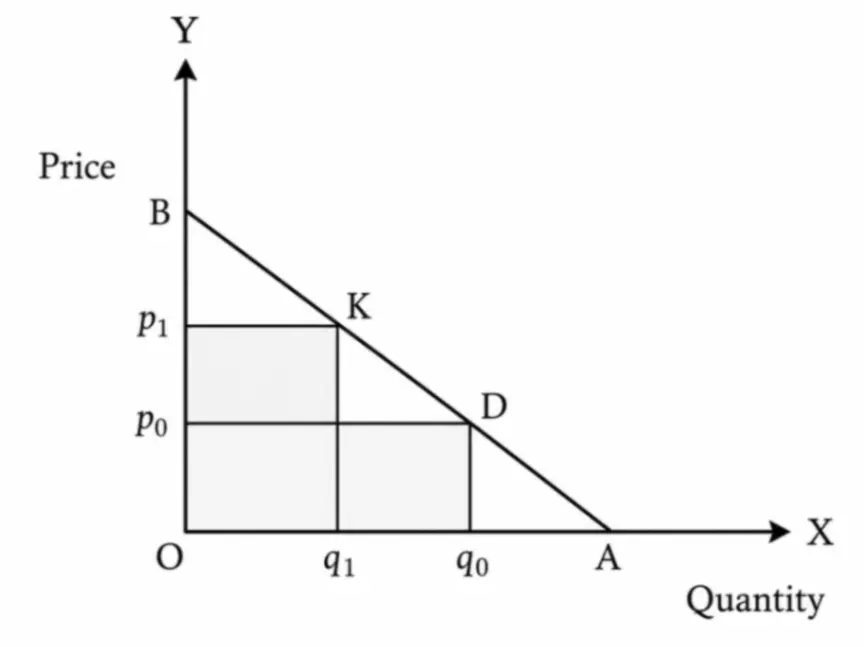
Identify normative statements from the following : (A) India has a high population (B) India should keep a control on population growth rate (C) High population hampers growth of any country (D) India should have more equitable distribution Choose the correct answer from the options given below :
Which of the following is studied under micro economics?
Which of the main factor is responsible to create economic problems in society?
Which of the following inequality represents the consumer's budget constraint ?